
Metallurgical Abstracts on Light Metals and Alloys vol. 58
Sensible/latent hybrid heat storage material using Solar Salt and Al–Cu–Si alloy-based phase change material
Yuto Shimizu*, Takahiro Kawaguchi**, Keita Tanahashi**, Tomokazu Nakamura**, Melbert Jeem** and Takahiro Nomura**
* Graduate School of Engineering, Hokkaido University
** Faculty of Engineering, Hokkaido University
[Published in Chemical Engineering Journal, Vol. 508 (2025), 160832]
https://doi.org/10.1016/j.cej.2025.160832
E-mail: y.shimizu2241[at]eng.hokudai.ac.jp
Key Words: Thermal energy storage, Phase change material, Aluminum alloy, Microcapsule, Molten salt
Advancements in thermal energy storage (TES) technology are essential for efficiently storing and utilizing renewable energy and industrial waste heat. Conventional molten-salt-based sensible heat storage systems, widely used in high-temperature applications, are limited by their low theoretical heat storage density. Alloy-based phase change materials (PCMs), particularly microencapsulated PCMs (MEPCMs), serve as a promising alternative because they exhibit superior heat storage density and thermal conductivity. The MEPCMs also mitigate issues such as leakage and corrosivity, while exhibiting handling characteristics similar to those of ceramic powders. This study introduces a novel hybrid heat storage material composed of NaNO3-40mass%KNO3 (Solar Salt) and an Al–Cu–Si-alloy-based MEPCM in a 1:1 wt ratio. The alloy, with a melting point of ∼520 °C, functions as an effective latent heat storage component within Solar Salt, demonstrating stability with no signs of degradation or reaction after 100 h of exposure to 560 °C or 100 thermal cycles. The hybrid material achieved a heat storage density of 1.09 GJ m−3 at a temperature difference of 250 °C—an increase of 154 % in relation to that achieved by Solar Salt alone. Additionally, the thermal conductivity of the hybrid material reached 2.27 W m−1 K−1 at 150 °C, nearly five times higher than that of Solar Salt. By adjusting the ratio of Solar Salt to Al–Cu–Si MEPCM, further improvements in heat storage density and thermal conductivity can be achieved. This approach provides a practical solution for enhancing TES performance in existing high-temperature molten salt systems, such as those used in concentrated solar power applications, with minimal modifications to the current infrastructure.
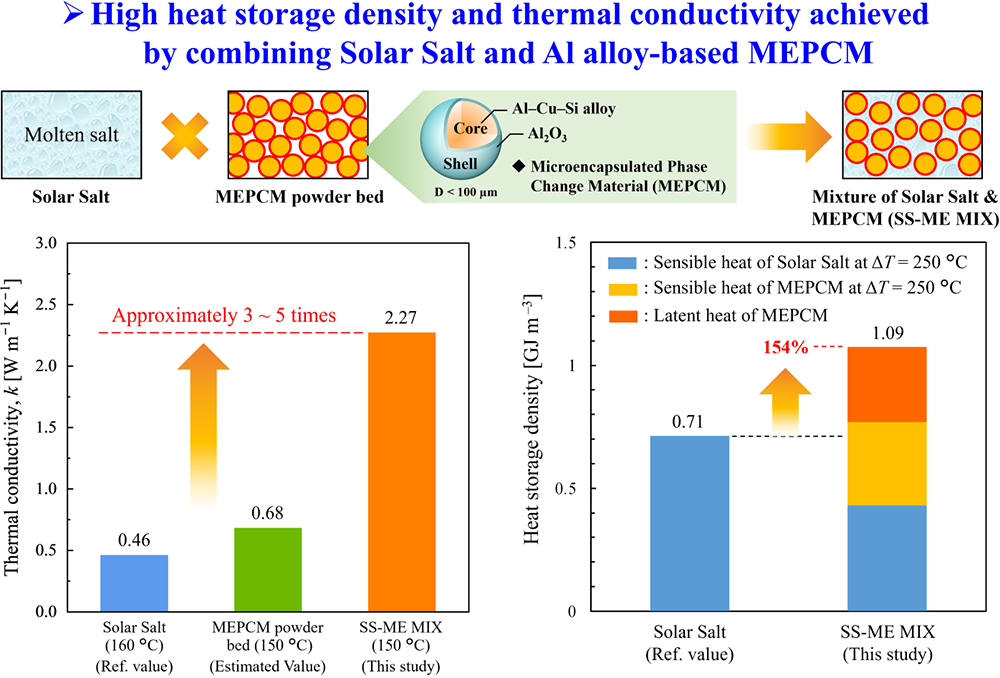
A hybrid heat storage material combining Solar Salt and Al–Cu–Si MEPCM was developed, offering higher heat storage density and thermal conductivity than either material alone.