
Metallurgical Abstracts on Light Metals and Alloys vol. 58
Die-cast Al–Si–Cu alloy (ADC12) as a phase change material for medium–high-temperature heat storage
Yuto Shimizu* and Takahiro Nomura**
* Graduate School of Engineering, Hokkaido University
** Faculty of Engineering, Hokkaido University
[Published in Journal of Alloys and Compounds, Vol. 1017 (2025), 179006]
https://doi.org/10.1016/j.jallcom.2025.179006
E-mail: y.shimizu2241[at]eng.hokudai.ac.jp
Key Words: Thermal energy storage, Phase change material, Aluminum alloy, Die-cast alloy, ADC12
Power-to-heat-to-power systems (Carnot batteries) that store thermal energy are gaining significant interest to enhance the utilization of renewable energy. The latent heat storage (LHS) system is a promising technology because of its high heat storage density and ability to deliver heat at a constant melting temperature of a phase change material. Existing infrastructure such as conventional coal-fired power plants and steam turbines can be effectively repurposed for Carnot batteries. This study investigates ADC12, a widely used aluminum die-cast alloy, as an LHS material for efficient operation within the typical temperature range of steam turbines. We characterized the thermophysical properties and evaluated the durability of ADC12 through repeated melting and solidification cycles. ADC12 melted in the range of 516–590 °C and exhibited a latent heat capacity of 411.1 J g−1. Furthermore, after 100 melting and solidification cycles in a dry N2 atmosphere, ADC12 retained its original morphology and phase change characteristics. ADC12 exhibited significantly higher heat storage density and thermal conductivity, which is 10 to 100 orders of magnitude greater than conventional sensible heat storage materials. Moreover, driven by the growing concern over the generation of non-recycled aluminum alloy scrap, the cost of aluminum casting and die-cast alloys is expected to further decrease. Consequently, using ADC12 as an LHS material can reduce the initial cost of LHS systems while effectively using aluminum resources.
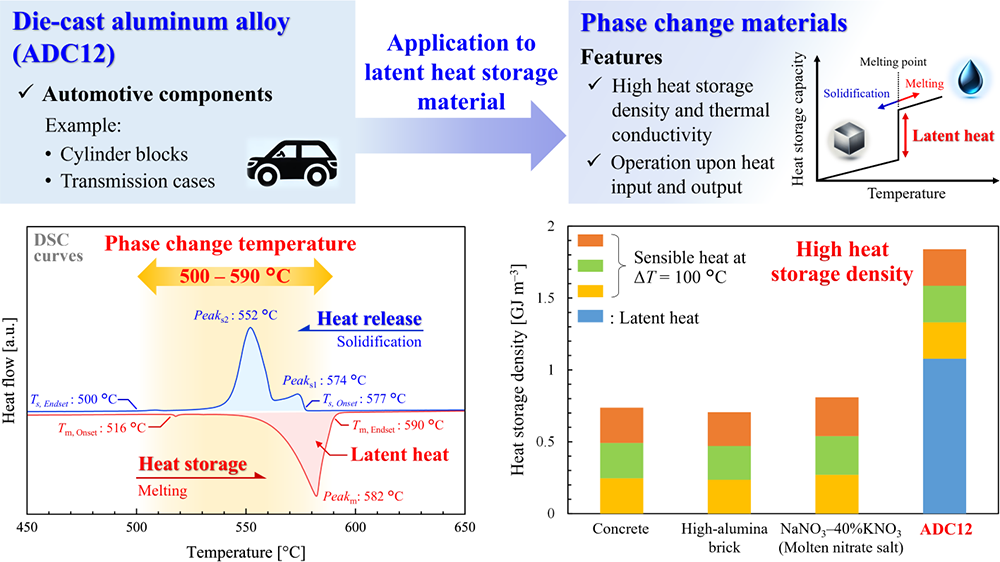
ADC12 melted at 516–590 °C and had a latent heat capacity of 411.1 J g−1. ADC12 had a heat storage density of approximately 1.84 GJ m−3 at ΔT = 300 °C.