
Metallurgical Abstracts on Light Metals and Alloys vol. 58
Deposition Morphology and Intermetallic Compound Formation at the Bonding Interface in Alloyed Steel on an Aluminum Alloys Using Laser Directed Energy Deposition
Takaharu Suzuki1,2, Hisashi Harada2, Motoko Yamada1, Hisashi Sato1 and Yoshimi Watanabe1
1 Department of Physical Science and Engineering, Nagoya Institute of Technology
2 Materials division, YAMAHA MOTOR CO., LTD.
[Published in Journal of Japan Institute of Light Metals, 75, 285-291, (2025).]
https://www.jstage.jst.go.jp/article/jilm/75/7/75_750710/_article/-char/en
E-mail: yoshimi[at]nitech.ac.jp
Key Words: Additive manufacturing, Directed energy deposition (DED), Dissimilar materials, Intermetallic compounds
When depositing dissimilar materials, several principal factors must be considered, including differences in melting points, the behavior of molten metals, and the formation of intermetallic compounds at interfaces. If the depositing conditions are not appropriate, laminating is not stable and interfacial delamination may occur. Therefore, the quality of the first layer of laminate is especially important to achieve a good adhesion. This study investigates the phenomena occurring near the interface during laser directed energy deposition. The results show that laser scanning speed significantly changes the deposition morphology. As the scanning speed increases, the deposition width decreases, while the melting width and depth increase. Under high scanning speed conditions, droplet sizes become smaller. So, the molten metal temperature rises rapidly during heating. The substrate is also heated more effectively. At the bonding interface, the dissolution of the aluminum alloy substrate and the formation of Fe–Al intermetallic compounds are occurring. These intermetallic compounds consist of elements from both the substrate and the deposition material. Furthermore, the growth rate of the intermetallic compounds at the bonding interface of silicon-containing aluminum alloys decreases as a result of the reduced diffusion rate.
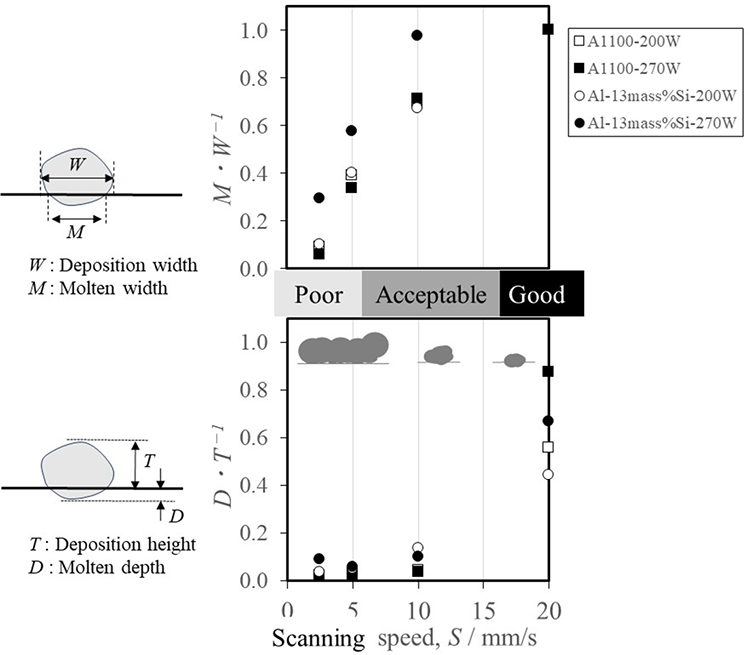
Process map for efficient deposition of the first layer.