
Metallurgical Abstracts on Light Metals and Alloys vol. 58
Hypervelocity Impacts on Aluminum Alloy/Titanium Alloy Composites Fabricated by Powder-Type Directed Energy Deposition
Masahiro Nishida, Tatsuhiko Sato and Yoshimi Watanabe
Nagoya Institute of Technology
[Published in International Journal of Impact Engineering, 206, 105391 (11pages), (2025).]
https://doi.org/10.1016/j.ijimpeng.2025.105391
E-mail: yoshimi[at]nitech.ac.jp
Key Words: Hypervelocity impact behavior, Experimental, Additive manufacturing, Directed energy deposition method
Additive manufacturing is currently undergoing a period of rapid adoption, particularly in the field of impact engineering. Various additive manufacturing processes are utilized for the fabrication of space components and structures. Because space debris orbit at very high velocities over 7 km/s, the potential for severe damage in the event of a collision is considerable. To prepare for the possibility of an unexpected collision with space debris, it is essential to understand the hypervelocity impact behaviors of space components and structures that are fabricated by additive manufacturing processes. Powder bed fusion (PBF) method is the most widely used among many additive manufacturing processes. The hypervelocity impact behaviors of parts and structures fabricated by the PBF method have been examined. In contrast, the directed energy deposition (DED) method, an additive manufacturing process, offers distinct advantages, including high fabrication speed, large-scale printing capabilities, and the production of functionally graded materials. In this study, the Al–10Si–0.4Mg alloy sample, Ti–6Al–4V alloy sample, and Al–10Si–0.4Mg/Ti–6Al–4V composite samples were fabricated using a DED machine. The composite sample with a mixing ratio of 80:20 (Al–10Si–0.4Mg:Ti–6Al–4V) was primarily utilized for strength evaluation. After the confirmation of their tensile properties, the hypervelocity impact behaviors using aluminum alloy projectiles were examined, with a focus on characteristics such as perforation holes, debris clouds (fragments on the rear side of the target), rear wall (fragmentation of projectiles), and backward ejecta (fragments) from the front side of the target. The results were compared with those of the Al–10Si–0.4Mg alloy sample and Ti–6Al–4V alloy sample.
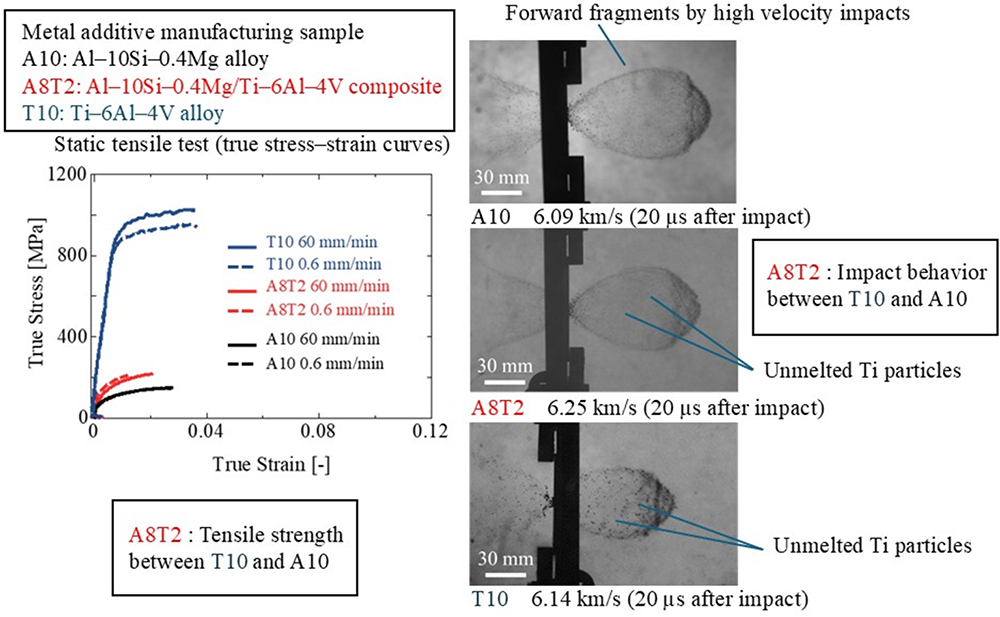
The better static strength and impact behaviors of Al–10Si–0.4Mg/Ti–6Al–4V composite samples fabricated using an additive manufacturing process were shown in the experiments.