
Metallurgical Abstracts on Light Metals and Alloys vol. 58
Crucible-less Processing of Ti with TiC Heterogeneous Nucleation Site Particles by Electrostatic Levitation
Yoshimi Watanabe1, Goro Takahashi1, Ryosei Saguchi1, Hisashi Sato1, Hirokazu Aoki2, Shinsuke Suzuki2,3, Shizuka Nakano4, Yuki Watanabe5,
Chihiro Koyama6, Hirohisa Oda6 and Takehiko Ishikawa6
1 Department of Physical Science and Engineering, Nagoya Institute of Technology, Gokiso-cho, Showa-ku, Nagoya, Aichi 466-8555, Japan
2 Department of Applied Mechanics and Aerospace Engineering, Waseda University, Tokyo Japan
3 Kagami Memorial Research Institute for Materials Science and Technology, Waseda University, Tokyo Japan
4 Henry Monitor, Inc., Nagano, Japan
5 Advanced Engineering Services Co., Ltd. (AES), Ibaraki Japan
6 Japan Aerospace Exploration Agency (JAXA), Ibaraki Japan
[Published in International Journal of Thermophysics, 45, 144 (20 pages), (2024)]
https://doi.org/10.1007/s10765-024-03435-y
E-mail: yoshimi[at]nitech.ac.jp
Key Words: Containerless processing, Electrostatic levitation, Titanium, TiC, Heterogeneous nucleation site, Density, Viscosity, Surface tension
In this study, the microstructure, hardness, density, viscosity, and surface tension of molten pure Ti with TiC particles were studied via electrostatic levitation experiments, where the electrostatic levitation experiment involved container-less processing, which can suppress heterogeneous nucleation via crucibles. Microstructural observation revealed long needle-shaped α-grains across the whole area in the pure Ti sample. On the other hand, smaller needle-shaped α-grains were found in the samples with TiC particles. However, detailed microstructural analysis of the Ti+0.7vol%TiC sample revealed that the fine α-grains observed in the Ti+0.7vol%TiC are transformed from a single grain of prior β phase. This is because the TiC particles dissolve into the molten Ti during the electrostatic levitation experiment. Instead, the Ti-rich TiC precipitates formed by cooling can act as pinning sites rather than heterogeneous nucleation sites, resulting in a finer microstructure for the samples with TiC particles during the electrostatic levitation experiment. The density of the samples is linearly related to the temperature and decreases with increasing temperature. In addition, a higher density is observed for the samples with TiC particles. Although linear relationships between the surface tension and temperature were found, the addition of TiC particles did not have a notable effect on the viscosity of the molten pure Ti.
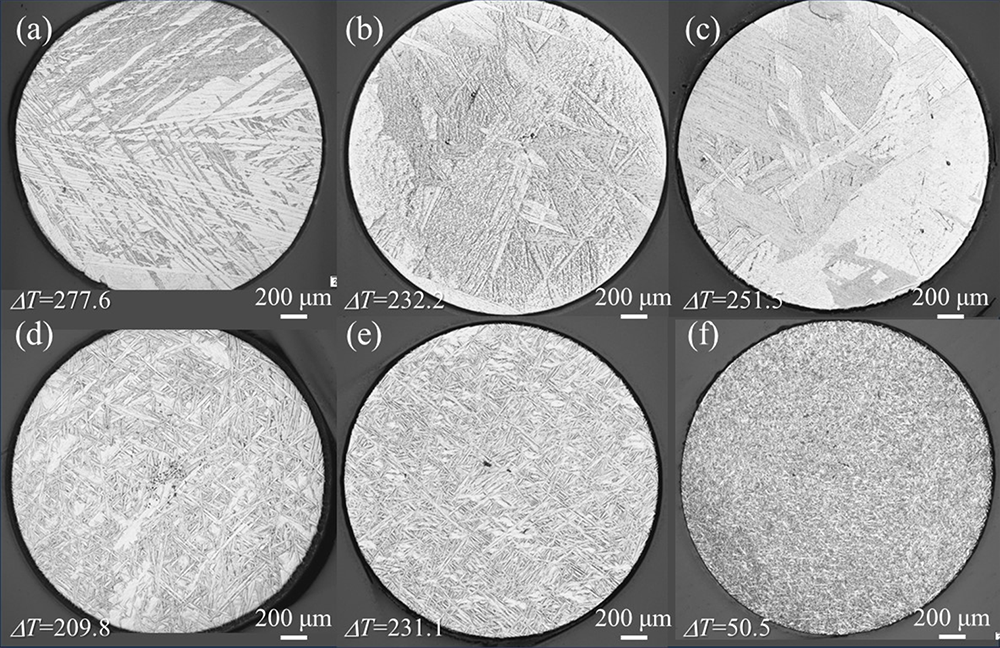
Microstructures of the (a) pure Ti, (b) Ti+0.11 mass% TiC, (c) Ti+0.33 mass% TiC, (d) Ti+0.56 mass% TiC, (d) Ti+0.67 mass% TiC and (d) Ti+ 1.11 mass% TiC samples. The degree of undercooling, ΔT, is also leveled in each figure.