
Metallurgical Abstracts on Light Metals and Alloys vol. 58
Four-Dimensional Electrochemical Impedance Spectroscopy: Role of Microstructure on Corrosion Behaviour of Al-Si Alloys Additive-Manufactured by Laser Powder Bed Fusion
Yoshinao Hoshi*, Ryo Miyazawa*, Yuki Otani**, Dasom Kim**, Naoki Takata** and Makoto Kobashi**
* Department of Engineering, Graduate School of Engineering, Nagoya Institute of Technology
** Department of Materials Process Engineering, Graduate School of Engineering, Nagoya University
[Published in Corrosion Science, Vol. 232 (2024), pp. 112018]
https://doi.org/10.1016/j.corsci.2024.112018
E-mail: hoshi.yoshinao[at]nitech.ac.jp
Key Words: Al-Si alloy, additive manufacturing, laser powder bed fusion, electrochemical impedance spectroscopy, 3D complex impedance plots, fine Si particles
Four-dimensional (4D) electrochemical impedance spectroscopy was applied to clarify the role of microstructures on the corrosion behaviour of Al-Si alloys additively manufactured by laser powder bed fusion in the immersion of NaCl solution. 3D complex impedance plots, comprising real, imaginary, and time axes, indicate that the impedance increases gradually at initial stage and then does not show apparent time variation. These behaviours, following surface morphology analysis, are strongly related to the remaining fine silicon particles on the surface due to the preferential Al dissolution, which suppress the further dissolution from underlying along with the protective oxide film formation.
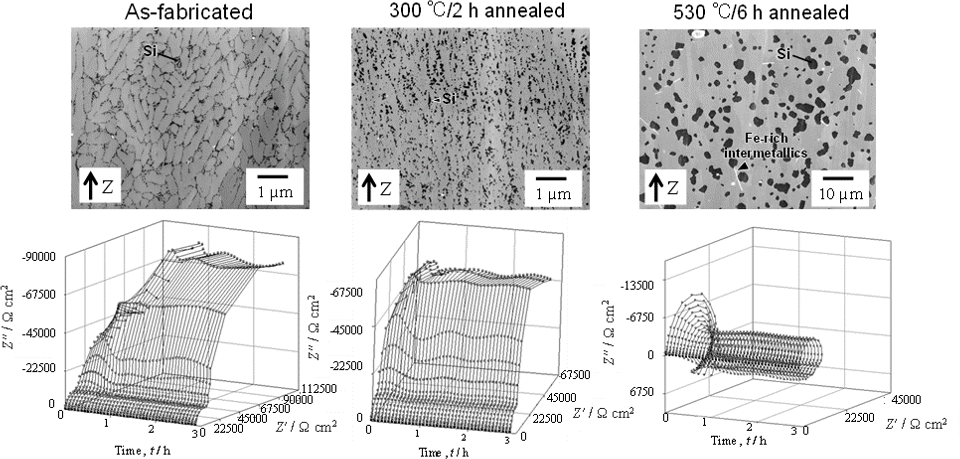
Above figures show relationship between microstructures and 3D complex impedance plots of Al-Si alloys additively manufactured by laser powder bed fusion. The annealed samples were used for the impedance measurements to investigate the effect of the microstructures on the corrosion behaviours.