Metallurgical Abstracts on Light Metals and Alloys vol. 58
Derivation of fatigue damage law for an aluminum alloy based on plastic-creep separation strain analysis
Towa Hayashibe*, Ken-ichi Ohguchi**, Katsuhiko Sasaki***, Kohei Fukuchi**, Shinya Honda***,
Yorimasa Tsubota****, Takuro Mita*****, Wataru Nagai****, Kouji Ohsato**** and Nobuaki Shinya****
* Graduate School of Engineering, Hokkaido University
** Department of Materials Science and Engineering, Akita University
*** Faculty of Engineering, Hokkaido University
**** ISUZU Motors Limited
***** ISUZU Advanced Engineering Center
[Published in International Journal of Fatigue, Vol. 198 (2025), 108964]
https://doi.org/10.1016/j.ijfatigue.2025.108964
E-mail: ken[at]gipc.akita-u.ac.jp
Key Words: Aluminum alloy, Low-cycle fatigue, Fatigue life prediction, Plastic-creep separation method, Particle swarm optimization
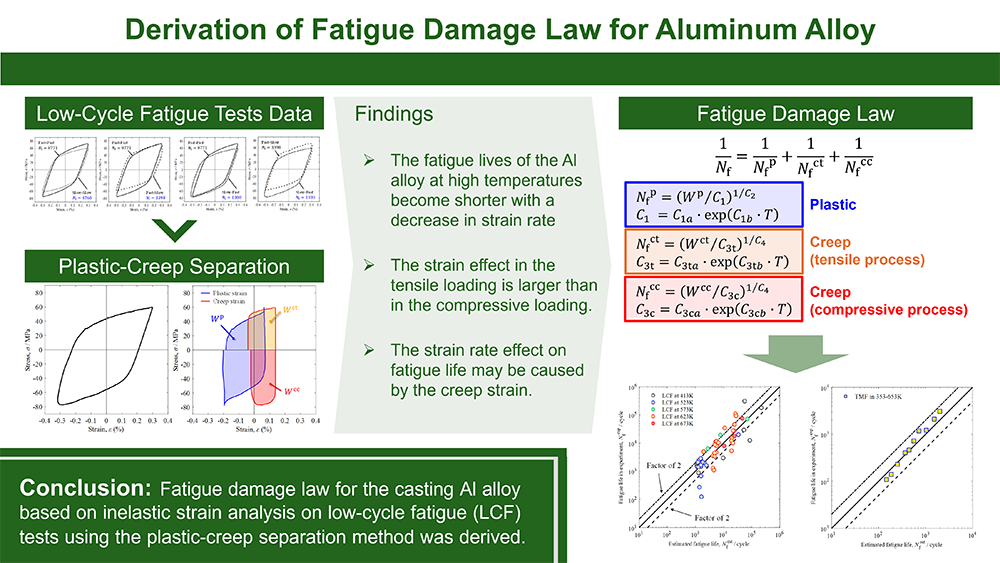
Aluminum (Al) alloys used for automobile engine components are subjected to fatigue loading at high temperatures over 1/2 of their melting temperatures Tm. The fatigue damage must be evaluated by a method that considers the effect of both the plastic and creep deformations because creep deformation occurs in the fatigue process at 1/2Tm. In this paper, the plastic-creep separation method is first applied to a casting Al alloy subjected to low cycle fatigue (LCF) loading, and a fatigue damage law is derived considering the effect of the plastic and creep damages on the fatigue life. Since Al alloy engine components are used at cyclically changing temperatures from room temperature to over 1/2 Tm, the fatigue damage law is adapted to the fatigue life due to cyclic thermal loading employing temperature-dependence parameters. Finally, the fatigue damage law is applied to the fatigue life evaluation for the thermo-mechanical fatigue (TMF) test that reproduces a real used condition of engines.