
Metallurgical Abstracts on Light Metals and Alloys vol. 58
Formation of Hydroxyapatite Surface Layer on Various Titanium Alloys by Fine Particle Peening
Shoichi Kikuchi*, Yuki Nakamura**, Koichiro Nanbu*** and Toshikazu Akahori****
* Department of Mechanical Engineering, Shizuoka University
** Department of Mechanical Engineering, National Institute of Technology
*** Department of Mechanical Engineering, Osaka Sangyo University
**** Department of Materials Science and Technology, Meijo University
[Published in Journal of Titanium Japan, Vol. 72, No. 3, (2024), 211-216]
https://ndlsearch.ndl.go.jp/en/books/R000000004-I033657804
E-mail: akahori[at]meijo-u.ac.jp
Key Words: titanium alloy, TNTZ, surface modification, biocompatibility
Titanium and titanium alloys have been widely applied for biomedical applications up to now. Ti-29Nb-13Ta-4.6Zr (TNTZ) is a new titanium alloy potentially to be used as bone implant material because of its advantages in terms of strength, ductility, non-toxicity, corrosion resistance, and biocompatibility. Mechanical surface modification such as a shot peening is one of beneficial methods for improving the fatigue properties of metallic materials. Especially among them, a fine particle peening (FPP) using hydroxyapatite (HAp) shot particles with excellent biocompatibility was introduced to form the HAp surface layer for improving the fatigue properties of alpha + beta and beta type titanium alloys such as; Ti-29Nb-13Ta-4.6Zr , Ti-22V-4Al, Ti-6Al-4V ELI and Ti-6Al-7Nb, and commercially pure (CP) titanium.
FPP could form a HAp layer on the surfaces of CP titanium and all titanium alloys within a relatively short time (1s) by HAp shot particle transfer without heating. In addition, FPP increased the surface hardness and generated compressive residual stress at the treated surface, which resulted in increasing the fatigue limit of CP titanium and titanium alloys under four-point bending. The HAp particles transferred layer remained on the surface without delamination after the fatigue tests.
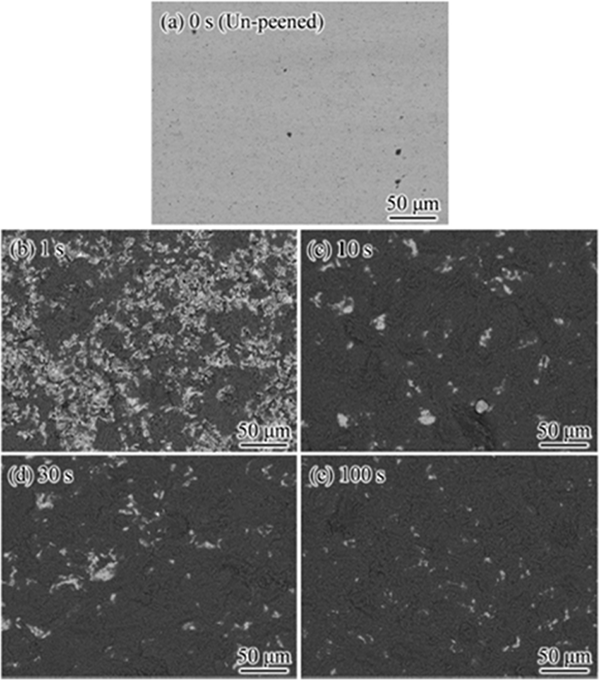
SEM micrographs of (a) un-peened TNTZ specimen and (b) to (e) TNTZ specimens with HAp layer after FPP for various treating times.