
Metallurgical Abstracts on Light Metals and Alloys vol. 58
Strength Analysis of Coarse Inclusion Particle in Wrought Magnesium Alloy
Akihiro Takahashi*, Takeru Hashiguchi* and Yoshitaka Kondo*
* Department of Mechanical Engineering, National Institute of Technology (KOSEN), Miyakonojo College
[Published in International Journal of Innovations in Engineering and Technology, Vol. 28(2025), Issue 1, pp. 1-6]
https://ijiet.com/wp-content/uploads/2025/07/1.pdf
E-mail: akihiro[at]cc.miyakonojo-nct.ac.jp
Key Words: Magnesium alloy, In situ observation, Fracture mechanics analysis, Particle strength
Mg alloys have highly strength-to-weight ratios and are applied to a wide range of engineering sectors. These alloys are suitable for applications where weight is a key concern, giving weight advantages over aluminum and stainless steel of 33% and as much as 70%, respectively. The strengths and toughness are their most important factors because of development in improving the properties of Mg alloys is extremely desirable and will advantage their applications as lightweight structural materials. In-situ SEM observation during interrupted three-point bending test were Carried out to investigate coarse intermetallic compound (IMC) particles strength in an AZ61 Magnesium (Mg) alloy based on fracture mechanics analysis. Coarse Mn-Al system IMC even adjacent to the fracture surface remains intact, while β-Mg17Al12 is extensively damaged around a crack-tip. A combination in HRR solution and Eshelby type internal stress analysis has been used to determine the particle strength of β-Mg17Al12 particle. The fracture strength of the β-Mg17Al12 particle was predicted to be 946 MPa.
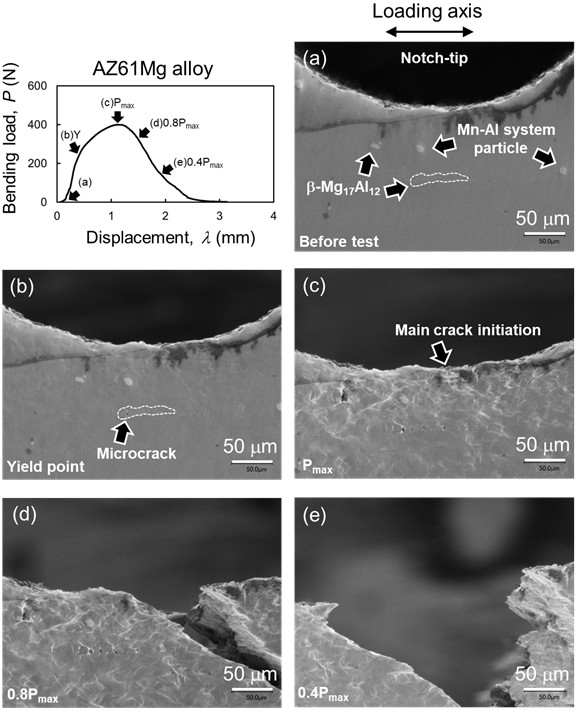
This shows sequential micrographs of microstructural damage and fractured inclusion behavior near the notch-tip in Mg alloy, with loading axis (horizontal). These graphs correspond to the loading points: (a) before the test and at (b) the Y, (c) Pmax, (d) 0.8Pmax, and (e) 0.4Pmax points.