
Metallurgical Abstracts on Light Metals and Alloys vol. 58
Safe Electropolishing Process for Aluminum and Its Alloys Using Sodium Chloride Glycol Solutions Without Perchloric Acid
Mana Iwai*, Tatsuya Kikuchi*, Daiki Nakajima**, Sho Kitano*, Koji Fushimi* and Hiroki Habazaki*
* Faculty of Engineering, Hokkaido University
** Research & Development Division, UACJ Corporation
[Published in Journal of The Electrochemical Society, Vol. 172 (2025), 023508]
https://doi.org/10.1149/1945-7111/adb7ca
E-mail: mana-iwai[at]eng.hokudai.ac.jp
Key Words: Electropolishing, Aluminum, Aluminum alloy, Ethylene glycol, Propylene glycol
A safe and straightforward process was developed for electropolishing aluminum surfaces using a nonhazardous electrolyte solution, specifically ethylene glycol (EG) or propylene glycol (PG) with NaCl, instead of perchloric acid. High-purity aluminum specimens were immersed in a slowly stirred electrolyte solution of EG or PG with NaCl and anodically polarized at 20–140 V for 2–30 min. At an optimal voltage of 40–60 V, the current density reached a constant value after an initial transition, resulting in uniform dissolution of the specimen’s surface and successful electropolishing. The surface reflectance exceeded 80% across the visible light spectrum, nearly matching that of an ideal specular plate. The surface showed numerous bumpy structures with a height of 10 nm and a roughness of 3.0 nm. This electropolishing method is also applicable to aluminum alloys (e.g., A1050, A5052, A6063, and A7075), improving the reflectance of these alloys by more than 20% compared to those of untreated surfaces.
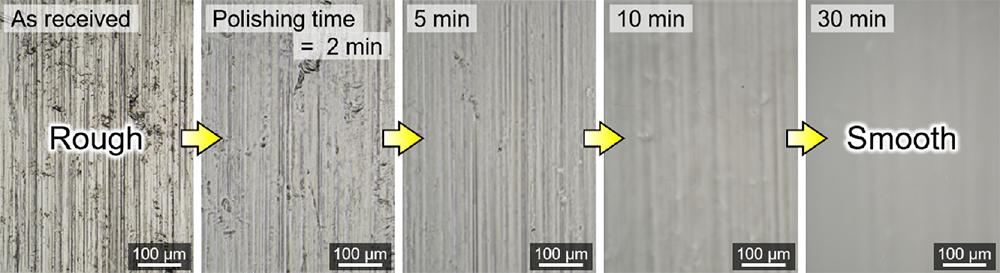
Optical microscopic images of as-received and electropolished aluminum specimens in a 0.2 M NaCl/PG solution at 303 K and U = 60 V for 2–30 min.