Metallurgical Abstracts on Light Metals and Alloys vol. 58
The Influence of [110] Compressive Stress on Kinetically Arrested B2–R Transformation in Single-Crystalline Ti–44Ni–6Fe and Ti–42Ni–8Fe Shape-Memory Alloys
Mitsuharu Todai*,**, Takashi Fukuda*** and Tomoyuki Kakeshita***,****
* Department of Environmental Materials Engineering, National Institute of Technology, Niihama College, Ehime, 792-8580, Japan
** Institute of Industrial Science, The University of Tokyo, 4-6-1, Komaba Megro-ku, Tokyo 153-8505, Japan
*** Department of Materials Science and Engineering, Graduate School of Engineering, Osaka University, 2-1, Yamada-oka, Suita 565-0871, Osaka, Japan
**** Department of Mechanical Engineering, Faculty of Engineering, Fukui University of Technology, 3-6-1, Gakuen, Fukui 910-0028, Fukui, Japan
[Published in Materials, Vol. 17 (2024), pp. 51]
https://www.mdpi.com/1996-1944/17/1/51
E-mail: m.todai[at]niihama-nct.ac.jp
Key Words: kinetics; shape-memory alloys; titanium–nickel alloys; thermal arrest; isothermal transformation; elastic constants
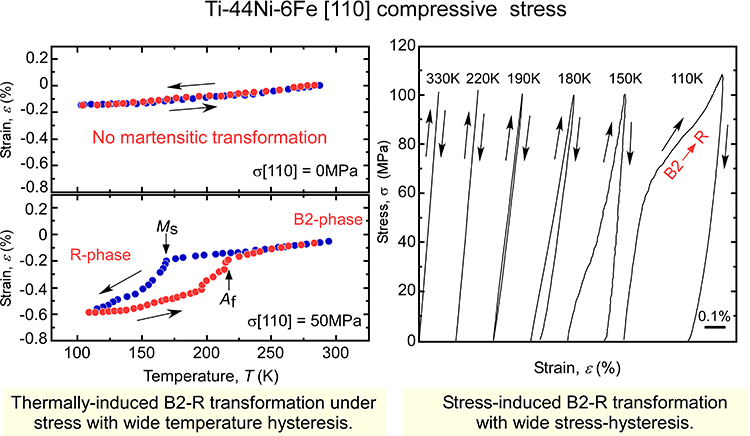
Ti–(50−x)Ni–xFe alloys exhibit a thermally induced B2–R martensitic transformation (MT) when x is between 1.5% and 5.7%, whereas this transformation is suppressed when x is 6 at% and higher. We studied the reason for this suppression by applying compressive stress in the [110]B2 direction to single-crystalline Ti–44Ni–6Fe and Ti–42Ni–8Fe (at%) alloys. Under stress, these alloys exhibit a B2–R MT with a large temperature hysteresis of ≥50 K. The B2–R MT in these alloys is probably thermally arrested, and a small entropy change is a possible reason for this arrest. The Young’s modulus E[110] of these alloys significantly decreases with decreasing temperature, and the B2–R MT under stress occurs at a temperature where E[110] is approximately 50 GPa. Presumably, lattice softening assists the B2–R MT.