
Metallurgical Abstracts on Light Metals and Alloys vol. 58
Dissimilar Welding of Magnesium Alloys and Aluminum Alloys by Explosive Welding
Mami Mihara-Narita*, Konosuke Asai*, Hisashi Sato*, Yoshimi Watanabe*, Isao Nakatsugawa**, Naobumi Saito** and Yasumasa Chino**
* Department of Physical Science and Engineering, Nagoya Institute of Technology
** National Institute of Advanced Industrial Science and Technology (AIST)
[Published in MATERIALS, Vol. 18 (2025), pp. 1013]
https://doi.org/10.3390/ma18051013
E-mail: narita.mami[at]nitech.ac.jp
Key Words: explosive welding, dissimilar joining, magnesium alloy, aluminum alloy, interlayer
Welding dissimilar magnesium alloys and aluminum alloys is challenging due to the formation of interlayers composed of brittle intermetallic compounds (IMCs) at the bonding interface, which reduces the bonding strength. In our studies, we applied explosive welding to facilitate dissimilar welding of magnesium alloys and aluminum alloys. This method utilized a high-speed impact from an explosive to bond magnesium alloys and aluminum alloys in a short time, effectively suppressing the formation of the interlayer. Our research confirmed the presence of a thin interlayer of the γ-Mg17Al12 phase at the interface of the cladding plates. The alloy compositions of both magnesium alloys and aluminum alloys influenced the thickness of this interlayer. Furthermore, annealing of the cladding plates increased the thickness of the interlayer, resulting in the formation of the aluminum-rich β-Al3Mg2 phase on the aluminum alloy side after annealing at 473 K. The formation of the brittle β- Al3Mg2 phase led to crack initiation, which reduced the shear strength. In terms of corrosion resistance, the corrosion weight loss of the explosively welded cladding plates was slightly less than that of mechanically fastened samples. Therefore, it can be concluded that explosive welding is highly effective for bonding magnesium alloys to aluminum alloys.
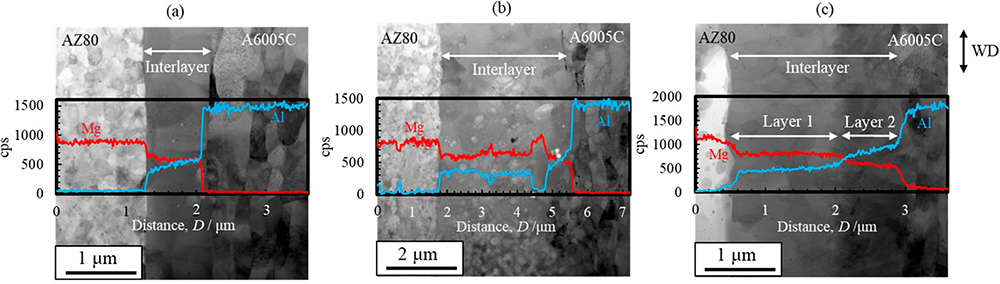
STEM images and line profiles of magnesium and aluminum compositions near the bonding interface of explosively welded AZ80/A6005C cladding plates ((a) as welded, (b) annealed at 373 K, and (c) annealed at 473 K for 24 h) .