Metallurgical Abstracts on Light Metals and Alloys vol. 58
Formation of corrosion-resistant coatings on cast AZ91D magnesium alloy using pulse electrolysis and the importance of coating morphology
Zheng Shao*, Masashi Nishimoto* and Izumi Muto*
* Department of Materials Science, Tohoku University
[Published in Surface & Coatings Technology, Vol. 513 (2025), 132473]
https://doi.org/10.1016/j.surfcoat.2025.132473
E-mail: masashi.nishimoto.b8[at]tohoku.ac.jp
Key Words: Magnesium alloy, Corrosion resistance, Pulse electrolysis, Coating
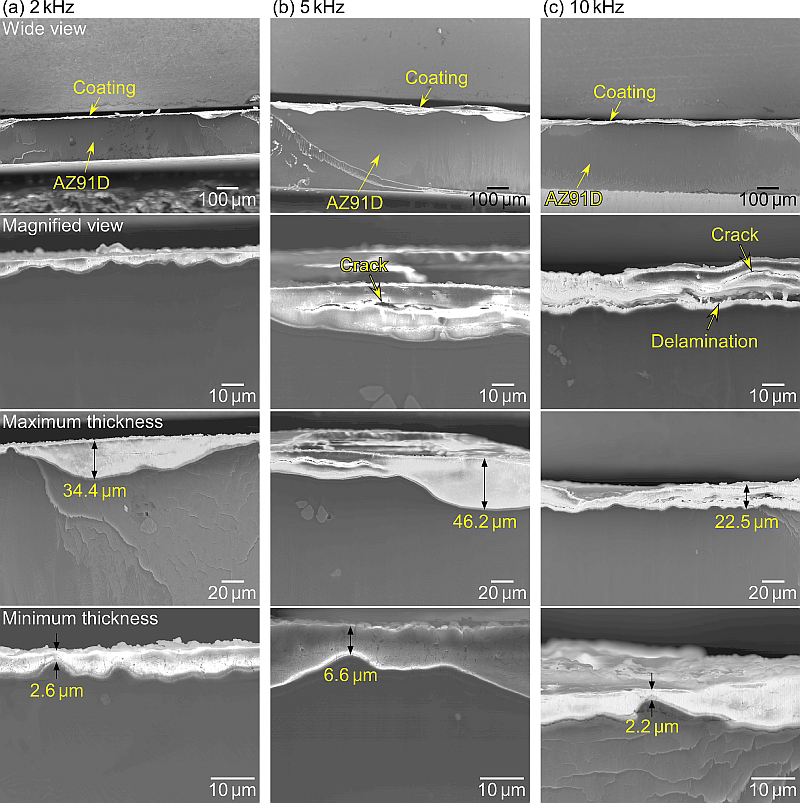
Pulse electrolysis was conducted in a 3 M KOH-0.21 M Na3PO4-0.15 M Al(NO3)3-0.6 M KF solution to form a corrosion-resistant coating on a cast AZ91D magnesium alloy. We investigated the effect of the pulse repetition frequency (2, 5, and 10 kHz) on the chemical composition, morphology, and corrosion performance of the coating. While the chemical compositions of the coatings were similar, the coating morphology varied with the repetition frequency. The coating on the 5 kHz specimen exhibited a thickness of up to approximately 46 μm without delamination, whereas the coatings on the 2 and 10 kHz specimens were thinner. The coating on the 10 kHz specimen contained many cracks, and delamination from the alloy substrate was observed. In 0.01 M NaCl (pH 8.0), the open circuit potential of the 5 kHz specimen remained at approximately −0.2 V, even though that of the 2 and 10 kHz specimens oscillated at approximately −1.4 V. Potentiodynamic polarization tests revealed that the coating on the 5 kHz specimen inhibited both anodic and cathodic reactions, exhibiting a passive state from approximately −0.5 V to 0.5 V. The superior corrosion resistance of the 5 kHz specimen was attributed to the greater coating thickness and the absence of delamination from the substrate.