
Metallurgical Abstracts on Light Metals and Alloys vol. 58
Effect of jointed interface on natural frequency and damping ratio of magnesium alloy bolted joints
Tristan Samuel Britton (Fujimori) *, Keisuke Inoue*, Yoshinao Kishimoto**, Yukiyoshi Kobayashi**, Satoru Kuga* and Yuuki Kawaharabashi*
* Graduate School of Integrative Science and Engineering, Tokyo City University
** Department of Mechanical Engineering, Tokyo City University
[Published in Proceedings of 2nd JSME International Conference on Materials & Processing (2025), Paper ID: 2F14]
E-mail: ykishimo[at]tcu.ac.jp
Key Words: bolted joints, magnesium alloy, finite element method, surface texture, interfacial stiffness, natural frequency, damping ratio, clamping force
This study has clarified the effects of jointed interface on vibrational characteristics of magnesium alloy bolted joints to establish an analyzing method. A bolted magnesium alloy specimen with different surface profiles, a steel specimen for comparison, and finite element method (FEM) were used to see, clamping force, natural frequency, and damping ratio of the bolted joints. Hammering tests and numerical simulations were obtained to clarify the relationship between surface roughness to the natural frequency and damping ratio. The numerical simulations were executed based on a mechanical model and tribology theories to simulate the mechanics of the tribological real contact area between jointed interfaces. Thus, the natural frequency of magnesium alloy joint does not have strong influence between different surface roughness, compared to the steel joint. The low Young’s modulus of the magnesium alloy joint creates the interfacial asperity to compress easier at any surface roughness. However, the damping ratio of magnesium alloy joint, having strong influence between different surface roughness. The low interfacial stiffness can have effects from different surface roughness due to the slipping and frictional loss on the interface. The surface roughness and interfacial stiffness should be well considered, especially analyzing the damping ratio for magnesium alloy joints.
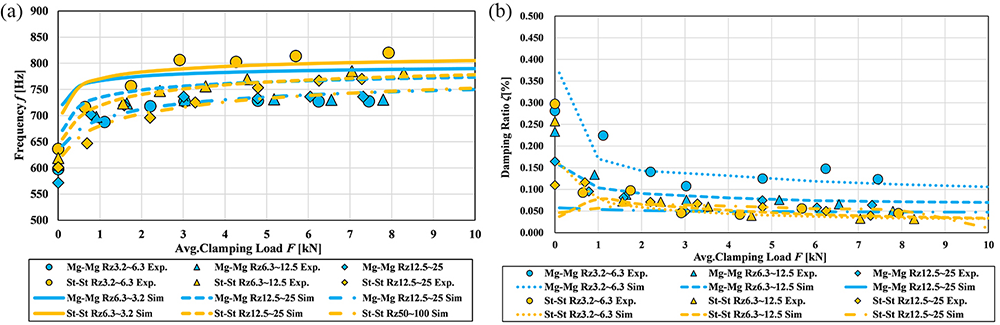
Results of hammering test and numerical simulation; (a) natural frequency, (b) damping ratio.