Metallurgical Abstracts on Light Metals and Alloys vol. 58
Material Properties and Friction and Wear Behavior of Ti–18 mass% Nb Alloy after Gas Nitriding and Quenching Process
Yoshikazu Mantani*, Miku Tsuji**, Eri Akada*** and Tomoyuki Homma****
* Department of Materials Science and Engineering, National Institute of Technology (KOSEN), Suzuka College
** Advanced Engineering Course of Science and Technology for Innovation, National Institute of Technology (KOSEN), Suzuka College
*** Mie Prefecture Industrial Research Institute Metal Science Branch
**** Department of Mechanical Engineering, Nagaoka University of Technology
[Published in Metals, Vol. 14 (2024), 944]
https://doi.org/10.3390/met14080944
E-mail: Mantani[at]mse.suzuka-ct.ac.jp
Key Words: titanium alloy, martensite, internal friction, wear resistance, coefficient of friction
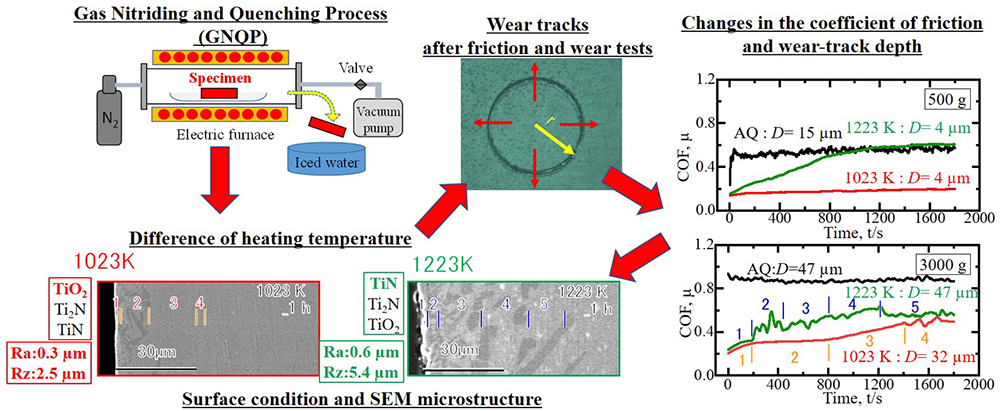
We performed a gas nitriding and quenching process (GNQP) on Ti–18 mass% Nb alloy to obtain a high damping capacity and wear resistance. GNQP was performed at temperatures of 1023, 1123, and 1223 K. The outermost surface of the GNQP specimen obtained at 1023 K mainly comprised TiO2, whereas that at 1223 K mainly comprised TiN. The surface and interior of the specimens ex-hibited higher hardness at 1223 K than that at 1023 K. Compared to the specimen obtained by solution–quenching (AQ), the unit volume of the α” martensite phase at a depth of 320 µm of the GNQP specimen obtained at 1023 K was similar, and that at 1223 K was higher. Such a difference can be related to the difference in the core hardness of the specimens. The wear amounts of all GNQP specimens were lower than those of the AQ specimen. The coefficient of friction of the GNQP specimen obtained at 1023 K was lower than that obtained at 1223 K. The surface constituent phase and surface roughness exhibited a strong influence on the wear at a load of 500 g. Meanwhile, the nitride layer and damping capacity were considered to be related to the wear at a load of 3000 g.