
Metallurgical Abstracts on Light Metals and Alloys vol. 58
Influence of deformation temperature on flow stress and dynamic metallurgical phenomena in Al–5.81Zn–1.65Mg alloy subjected to thermomechanical processing
Hyung-Won Park*, Hyeon-Woo Park**, Yuki Shimomura***, Yun-Soo Lee****, Hyeon-Woo Son****, Sungho Jeon*****, Tomohiro Hata* and Jun Yanagimoto***
* Faculty of Production Systems Engineering and Sciences, Komatsu University
** Samsung Display Co. Ltd.
*** Department of Mechanical Engineering, The University of Tokyo
**** Lightweight Materials Research Division, Korea Institute of Materials Science
***** Department of Materials Science and Engineering, University of Pennsylvania
[Published in Materials Today Communications, Vol. 42 (2025), 111208]
https://doi.org/10.1016/j.mtcomm.2024.111208
E-mail: hyungwon.park[at]komatsu-u.ac.jp
Key Words: Al–Zn–Mg alloy, Thermomechanical processing, Flow curve, Dynamic recrystallization, Strain-induced dynamic precipitation
To advance the T5 treatment process for Al–5.81Zn–1.65Mg alloys, this study explored the influence of deformation temperature on the solution temperature, ultrafine grain (UFG) formation via dynamic recrystallization (DRX), and strain-induced dynamic precipitation (SIDP) during thermomechanical processing at 300–500°C, with a 70% reduction and a strain rate of 1 s-1. The flow curve exhibited pronounced work hardening (WH) at 300–350°C, whereas a dynamic recovery-type flow curve was observed at 450–500°C. As the temperature increased from 300 to 500°C, the 1st WH rates (ε=0.2−0.4) were 55, 37.5, 20, 8.5, and 10 MPa, respectively. Larger DRX grains were formed at higher temperatures. The DRX rate ranged 20%–30% at 300–400°C and increased to 60% at 500°C. The texture gradually transitioned from Goss {011}<100> to brass {110}<112> with an increase in the deformation temperature from 300 to 500°C. Discontinuous DRX occurred mainly near the grain boundaries and precipitates at 300–400°C, shifting to continuous DRX at temperatures ranging from 400 to 500°C. At 300 and 400°C, larger precipitates (10–50 nm) and smaller ones (<10 nm) were observed within grains and along boundaries. Precipitates at 300°C were larger and denser than those at 400°C, with η’, and T’ phases formed through SIDP. For this alloy, considering the formation of UFG and ensuring sufficient solubility, the appropriate deformation temperature range was 400–500°C.
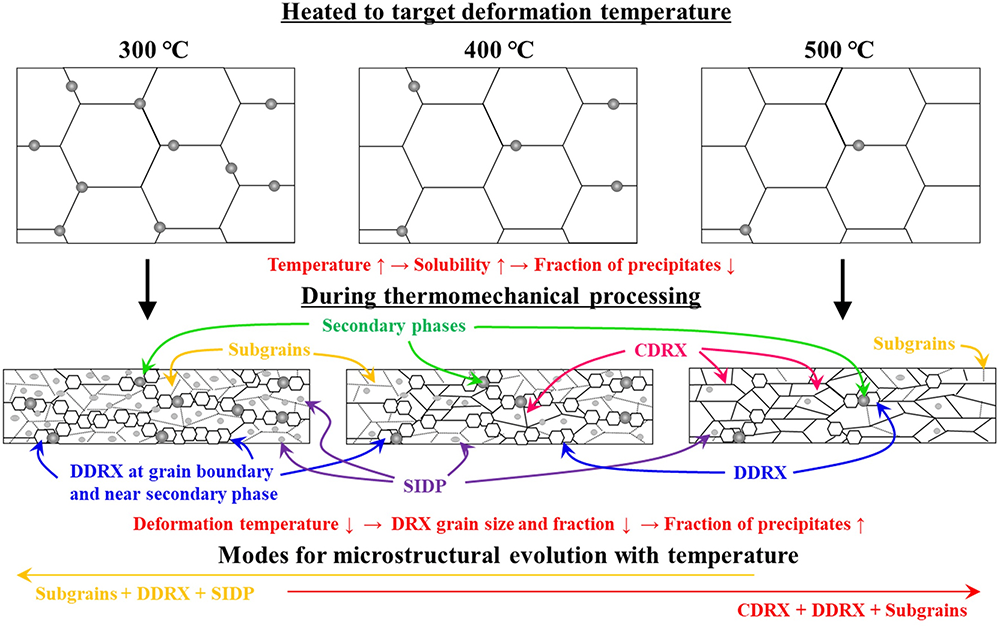
Graphical Abstract
Schematic of the metallurgical phenomena occurring in Al–5.81Zn–1.65Mg alloy during thermomechanical processing.