Metallurgical Abstracts on Light Metals and Alloys vol. 58
Amorphous alumina: an ideal material for advancing pentacoordinated aluminum chemistry and verifying its catalytic properties
Rei Okuno1, Tetsuya Kinjo1, Zen Maeno2, Hirooki Kajiwara1, Ayaka Ishi3, Naoto Kuwamura4, Yohei Onodera5,6, Shinji Kohara5,7, Koji Yazawa8,
Kenzo Deguchi9, Shinobu Ohki9, Shunsuke Shimizu10, Toshimasa Seki11, Hiroki Nagai12, Yuto Okawara1, Ryuichi Maekawa1,
Takeharu Yoshii10,13, Kiyoshi Nakahara11, Toshinori Okura3 and Hideki Hashimoto3,5,13
1 Applied Chemistry and Chemical Engineering Program, Kogakuin University, 2665-1 Nakano, Hachioji, Tokyo 192-0015, Japan
2 Department of Environmental Chemistry and Chemical Engineering, Kogakuin University, 2665-1 Nakano, Hachioji, Tokyo 192-0015, Japan
3 Department of Applied Chemistry, School of Advanced Engineering, Kogakuin University, 2665-1 Nakano, Hachioji, Tokyo 192-0015, Japan
4 Division of Liberal Arts, Center for Promotion of Higher Education, Kogakuin University, 2665-1 Nakano, Hachioji, Tokyo 192-0015, Japan
5 Center for Basic Research on Materials, National Institute for Materials Science, 1-2-1 Sengen, Tsukuba, Ibaraki 305-0047, Japan
6 Institute for Integrated Radiation and Nuclear Science, Kyoto University, 2-1010 Asashiro-nishi, Kumatori-cho, Sennan-gun, Osaka 590-0494, Japan
7 Graduate School of Science and Technology, Tokyo University of Science, 2641, Yamazaki, Noda, Chiba 278-8510
8 JEOL, 3-1-2 Musashino, Akishima, Tokyo 196-8558, Japan
9 NMR Station, National Institute for Materials Science (NIMS), 3-13 Sakura, Tsukuba, Ibaraki, 305-0003, Japan
10 Institute of Multidisciplinary Research for Advanced Materials, Tohoku University, 2-1-1 Katahira, Aoba-ku, Sendai, Miyagi, 980-8577, Japan
11 Titan Kogyo, Ltd., 1978-25 Ohaza Kogushi, Ube, Yamaguchi 755-8567, Japan
12 Department of Applied Physics, School of Advanced Engineering, Kogakuin University, Tokyo 192-0015, Japan
13 PRESTO, Japan Science and Technology Agency (JST), Kawaguchi, Saitama, 332-0012, Japan
[Published in Applied Materials Today, Vol. 44 (2025), 102710]
https://doi.org/10.1016/j.apmt.2025.102710
E-mail: hideki-h[at]cc.kogakuin.ac.jp
Key Words: amorphous materials, oxides, nuclear magnetic resonance, high-energy X-ray diffraction, catalysts
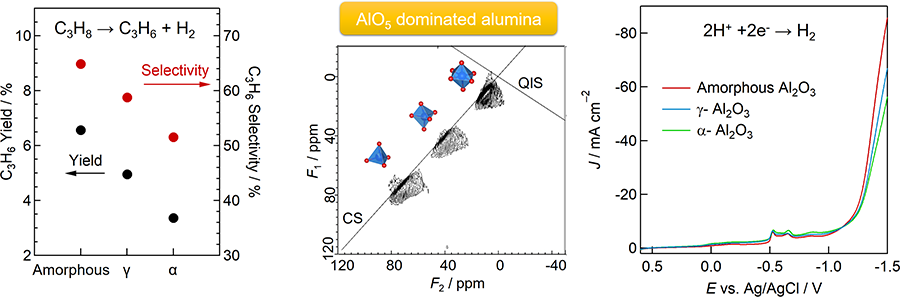
Pentacoordinated aluminum (AlV) sites, which are infrequently observed in crystals, have been shown to enhance material properties such as catalytic and mechanical performances. We synthesized porous amorphous alumina particles using a straightforward precipitation method and demonstrated the catalytic benefits of AlV sites. While the sample contained trace amounts of hydroxyl groups and physisorbed water, it was entirely amorphous, consisting primarily of AlO4, AlO5, and AlO6 units, with AlO5 as the dominant component. This material exhibited catalytic activity in the dehydrogenation of propane. When paired with a molecular complex that facilitates electrocatalytic hydrogen generation, it resulted in an increased catalytic current and a reduction in overpotential. The AlV sites are believed to play a crucial role in these enhancements. With its abundant AlV sites throughout both the interior and surface, amorphous alumina serves as an ideal material for advancing the "chemistry of pentacoordinated aluminum."