
Metallurgical Abstracts on Light Metals and Alloys vol. 58
Effects of beryllium segregation along grain boundaries of Y2O3 film in Mg–Zn–Y alloy on nonflammability and oxidation resistance
Shin-ichi Inoue *, Chih-Wei Sung**, Peng-Wei Chu**, Loku Singgappulige Rosantha Kumara*** and Yoshihito Kawamura*
* Magnesium Research Center, Kumamoto University
** Department of Engineering and System Science, National Tsing Hua University
*** Japan Synchrotron Radiation Research Institute (JASRI)
[Published in materials today communications, Vol. 47 (2025), Art. No. 113098]
https://doi.org/10.1016/j.mtcomm.2025.113098
E-mail: shinoue7[at]kumamoto-u.ac.jp
Key Words: Mg alloy, Yttrium, Beryllium, Nonflammable, APT
Our previous study showed that the nonflammability and oxidation resistance of Mg–Zn–Y alloys are improved by adding beryllium (Be). Mg–Zn–Y alloys with Be ignite at a high ignition temperature of 1320 K owing to the thinly and uniformly Y2O3 film formed. In this study, atom probe tomography (APT) together with soft X-ray emission spectroscopy (SXES) was conducted to investigate Be location in the oxide film, the chemical state of Be, and the mechanism by which the Y2O3 film was improved. APT and SXES measurements revealed the presence of metallic Be and BeO along Y2O3 grain boundaries. This suggests that the grain boundary segregation of Be prevents the oxygen inward diffusion via Y2O3 grain boundaries and improves the nonflammability and oxidation resistance of Mg–Zn–Y alloys through the reactive element effect.
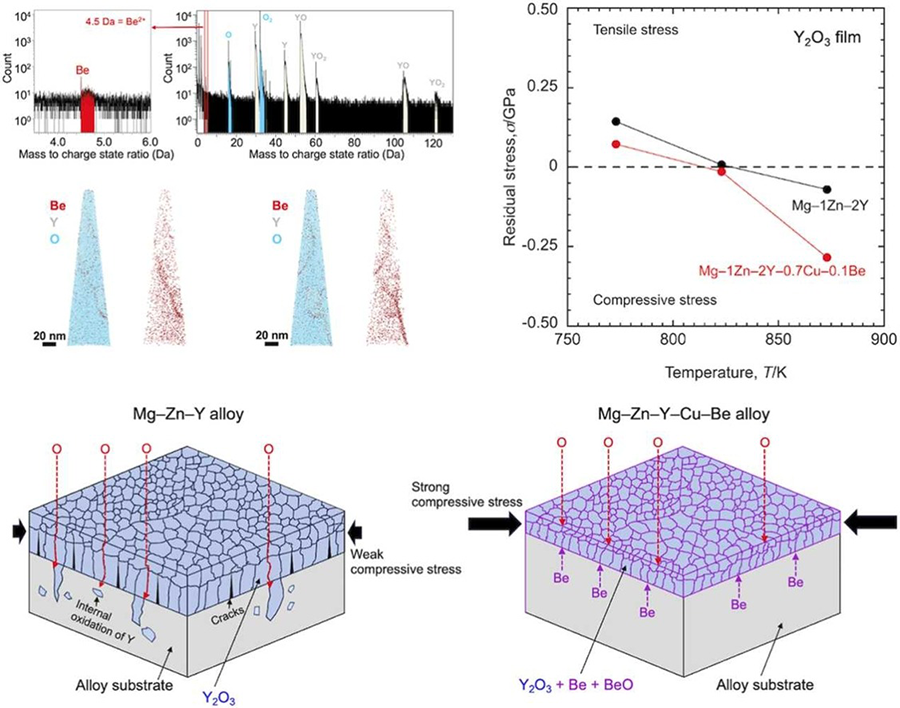
Nonflammability and oxidation resistance of Mg–Zn–Y alloys enhanced by beryllium segregation at grain boundaries of Y2O3 film.