
Metallurgical Abstracts on Light Metals and Alloys vol. 58
Assessment of hydrogen embrittlement behavior in Al-Zn-Mg alloy through multi-modal 3D image-based simulation
Hiro Fujihara*, Hiroyuki Toda*, Ken-ichi Ebihara**, Masakazu Kobayashi***, Tsuyoshi Mayama****, Kyosuke Hirayama*****, Kazuyuki Shimizu******, Akihisa Takeuchi******* and Masayuki Uesugi*******
* Department of Mechanical Engineering, Kyusyu University
** Center for Computational Science & e-Systems, Japan Atomic Energy Agency
*** Department of Mechanical Engineering, Toyohashi University of Technology
**** Department of Materials Science and Engineering, Kumamoto University
***** Department of Materials Science and Engineering, Kyoto University
****** Department of Physical Science and Materials Engineering, Iwate University
******* Japan Synchrotron Radiation Research Institute
[Published in International Journal of Plasticity, Vol. 174 (2024), 103897]
https://doi.org/10.1016/j.ijplas.2024.103897
E-mail: fujihara[at] mech.kyushu-u.ac.jp
Key Words: Hydrogen embrittlement, Al-Zn-Mg alloys, X-ray tomography, Diffraction contrast tomography, 3D image-based simulation, Crystal plasticity finite element method, Hydrogen diffusion
Hydrogen can strongly embrittle aluminum alloys by accumulating at precipitate interface and triggering transgranular cracking, due to stress-driven hydrogen diffusion towards crack tip and grain boundaries. However, although mechanical features near crack tip and grain boundaries, and hydrogen diffusion/trapping processes have been extensively studied separately, very few quantitative information regarding the local interactions between hydrogen distribution and stress fields with full spatial complexity has been revealed. The present study attempts to fill this gap, by using a multi-modal three-dimensional image-based simulation that combines a crystal plasticity finite element method with hydrogen diffusion analysis, to fully capture the actual stress distribution and its effect on hydrogen distribution, and more importantly on cracking probability, near a real propagating hydrogen-induced crack. Stress-diffusion-trapping coupled simulations indicate the intergranular crack transitioned to a quasi-cleavage crack in the region where the interfacial cohesive energy of semi-coherent interface of the MgZn2 precipitate was reduced by hydrogen accumulation near the crack tip. The multi-modal three-dimensional image-based simulation used in the present study successfully bridged nanoscopic debonding and macroscopic hydrogen embrittlement fracture behavior.
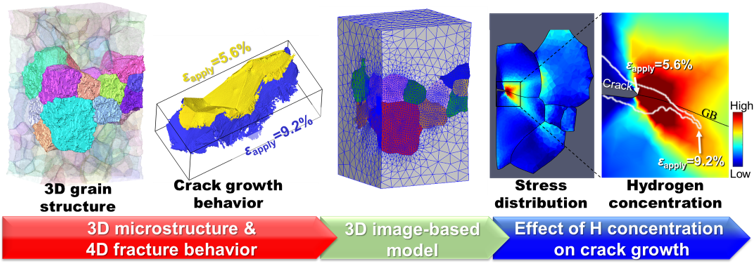
Schematic illustration of multi-modal 3D image-based simulation to evaluate the relationship between local stress concentration, hydrogen accumulation and crack growth behavior in Al-Z-Mg alloy.