
Metallurgical Abstracts on Light Metals and Alloys vol. 58
Effect of Cooling Rate on Powder Characteristics and Microstructural Evolution of Gas Atomized β-Solidifying γ-TiAl Alloy Powder
Sung-Hyun Park*, Ryosuke Ozasa*, Ozkan Gokcekaya*, Ken Cho*, Hiroyuki Y. Yasuda*, Myung-Hoon Oh**, Young-Won Kim*** and Takayoshi Nakano*
* Graduate School of Engineering, The University of Osaka
** School of Materials Science and Engineering, Kumoh National Institute of Technology
*** Gamteck LLC
[Published in Materials Transactions, Vol.65 (2024), pp. 199-204]
https://doi.org/10.2320/matertrans.MT-M2023174
E-mail: k_cho[at]mat.eng.osaka-u.ac.jp
Key Words: Additive manufacturing, Titanium aluminide, Microstructure control, Mechanical properties
The gas atomization is a production technique of a metallic powder for additive manufacturing (AM) processes. In this study, the β-solidifying Ti-44Al-6Nb-1.2Cr alloy powder fabricated by gas-atomization was investigated regarding the evolving shape, phase constitution, and chemical distribution as a result of the high solidification rate. The powder showed a spherical shape regardless of its size, indicating no relation of solidification rate to powder shape. However, the small powder (D50 = 36.0 µm) showed less segregation and was composed of β and α2 dual phases. On the other hand, the large powder (D50 = 78.7 µm) is relatively high segregation and composed of almost a single α2 phase because of the difference in the cooling rates. The findings obtained here demonstrated the understanding of phase transformation during the rapid solidification and continuous microstructural evolution process in the β-solidifying alloy.
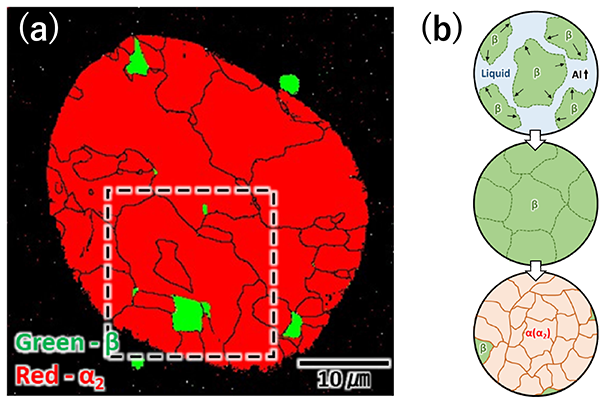
The phase map of the TiAl powder with the β and α2 phase (a) and schematic illustrations of the subsequent microstructural evolution (b).