Metallurgical Abstracts on Light Metals and Alloys vol. 58
Improvement of Cold Malleability of Magnesium Alloy by Combining Compression with Cyclic Torsion
Keisuke Tonomura*, Ryo Matsumoto*, Shinobu Kaneko** and Hiroshi Utsunomiya*
* Division of Materials and Manufacturing Science, Osaka University
** Department of Maritime Safety Technology, Japan Coast Guard Academy
[Published in Materials Today Communications, Vol. 46 (2025), 112828]
https://doi.org/10.1016/j.mtcomm.2025.112828
E-mail: ryo[at]mat.eng.osaka-u.ac.jp
Key Words: Magnesium alloy, Forging, Torsion, Malleability, Forgeability
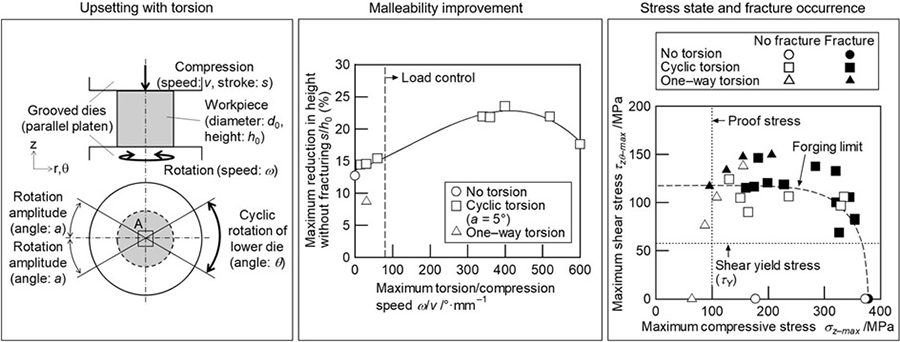
Torsion was applied to improve the malleability (forgeability) of commercial AZ31B (Mg-3mass%Al-1mass%Zn) magnesium alloy in forming at room temperature. The cylindrical workpiece was simultaneously compressed in the height direction and twisted with cyclic or one-way in the circumferential direction with respect to the compression axis. In this study, the relationship between torsion conditions (speed and amplitude) and fracture occurrence was investigated in upsetting. The maximum reduction in height without fracturing was improved from approximately 12% to approximately 23% in upsetting with cyclic torsion at a rotation/compression speed of 400°/mm. The mechanism of the malleability improvement was discussed from viewpoints of the stress state and the microstructure evolution. The malleability improvement was induced by the combination of compressive stress with approximately 20% reduction and shear stress with approximately twice as high as the shear yield stress. In addition, plastic deformation was promoted by the activation of twinning deformation in upsetting with cyclic torsion. On the other hand, the malleability improvement was verified in backward extrusion type forging with torsion.