
Metallurgical Abstracts on Light Metals and Alloys vol. 58
Hydrogen-induced pore formation in Ni–P-plated Al–Zn–Mg alloys revealed by synchrotron X-ray computed tomography and hydrogen detection
Keitaro Horikawa*, Makoto Hino**, Kazuyuki Shimizu***, Hiroyuki Toda****, Masato Hoshino***** and Kentaro Uesugi*****
* Department of Mechanical Science and Bioengineering, Osaka University
** Department of Mechanical System Engineering, Hiroshima Institute of Technology
*** Faculty of Engineering, Tottori University
**** Department of Mechanical Engineering, Kyushu University
***** Japan Synchrotron Radiation Research Institute
[Published in International Journal of Hydrogen Energy, Vol. 82 (2024), 801-809]
https://doi.org/10.1016/j.ijhydene.2024.07.380
E-mail: horikawa[at]me.es.osaka-u.ac.jp
Key Words: Al–Zn–Mg alloy, Hydrogen analysis, Hydrogen-associated defect, Ni–P plating, X-ray computed tomography
The internal microstructures of Ni–P-plated Al–Zn–Mg-based alloys were investigated using synchrotron X-ray computed tomography, together with various analytical methods for hydrogen detection. We clarified that hydrogen-induced pores were generated and segregated near the top and bottom surfaces of a rolled sheet of a commercial-purity Al–Zn–Mg-based alloy with Ni–P plating. In contrast, such segregation of hydrogen micropores was not observed in the high-purity-grade Al–Zn–Mg alloys with Ni–P plating. This result suggests that hydrogen enters the Ni–P plating layer during the plating operation and generates pores in the surface region owing to surface inclusions. Additionally, the hydrogen-induced defects deteriorated the tensile properties, such as tensile strength and elongation of the Al–Zn–Mg-based alloys containing higher levels of impurities such as Fe and Si with Ni–P plating.
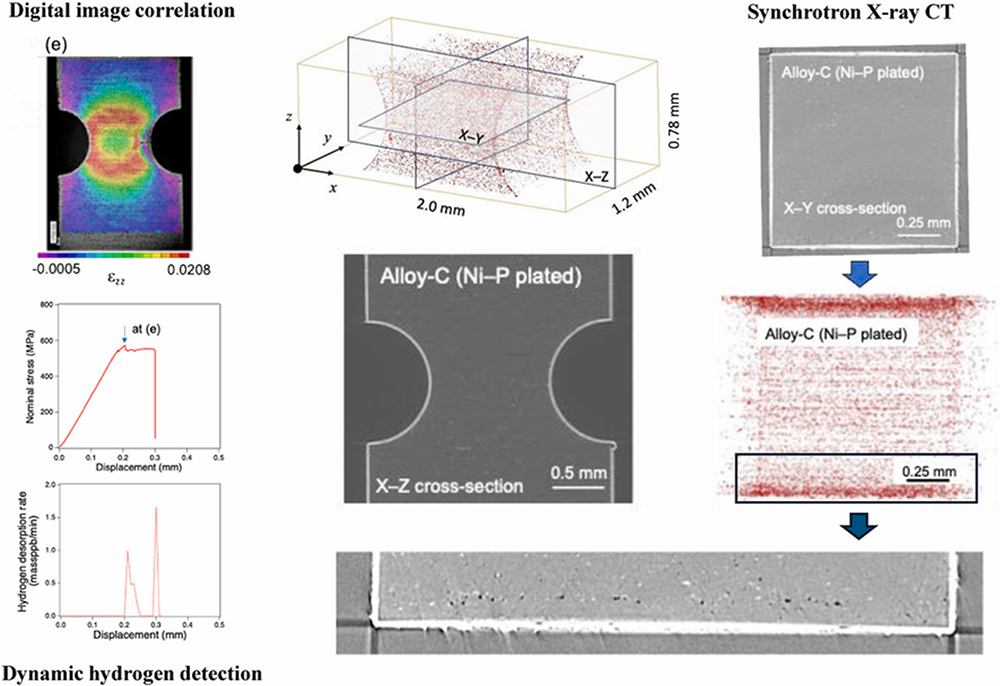
Synchrotron X-ray computed tomography, together with various analytical methods for hydrogen detection in Al–Zn–Mg-based alloy with Ni–P plating.