
Metallurgical Abstracts on Light Metals and Alloys vol. 58
Evaluation of Hydrogen Embrittlement of Three Aluminum Alloys by Three-Point Bending Test Affected by Three Types of Plating
Kota Kawaue*, Makoto Hino*, Ryoichi Kuwano*, Yukinori Oda**, Keitaro Horikawa*** and Teruto Kandani****
* Department of Mechanical Systems Engineering, Faculty of Engineering, Hiroshima Institute of Technology
** C. Uyemura & Co., Ltd.
*** Graduate School of Engineering Science, Osaka University
**** Okayama University of Science, Okayama 700-0005, Japan
[Published in Materials Transactions, Vol. 66 (2025), pp. 165-170]
https://doi.org/10.2320/matertrans.MT-L2024009
E-mail: m.hino.j3[at]cc.it-hiroshima.ac.jp
Key Words: aluminum alloy, hydrogen embrittlement, plating, three-point bending test, thermal desorption analysis
Hydrogen embrittlement affected by three types of plating (low-P and high-P types electroless Ni-P plating and electrolytic zinc plating) was investigated by means of slow-strain-rate three-point bending test on three aluminum alloys (2017-T3, 6061-T6 and 7075-T651). Hydrogen generated by the Ni-P and zinc plating was absorbed in the aluminum alloy substrates, and the trap sites in the aluminum alloy substrates for the absorbed hydrogen differed between Ni-P and zinc plating. Hydrogen embrittlement was able to be evaluated by the three-point bending tests on plated aluminum alloys. Zinc plating did not cause embrittlement for all the alloys, but Ni-P plating induced embrittlement only for the 6061-T6 aluminum alloy. The result of embrittlement of the Ni-P plated 6061-T6 aluminum alloy corresponds to the highest amount of hydrogen desorbed below 240°C than the other alloys.
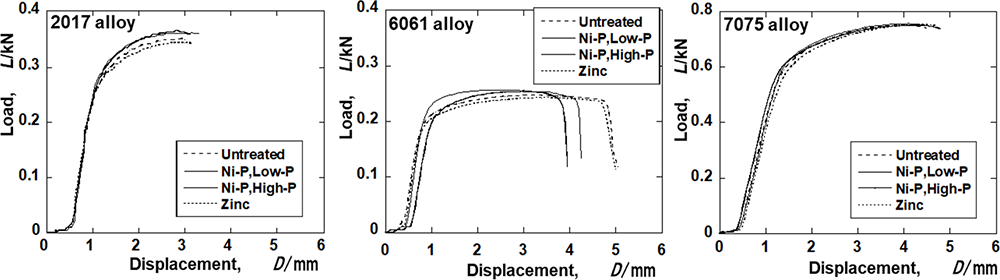
Load-displacement curves of the three alloy substrates untreated and plated in the three ways, subjected to the three-point bending test.