
Metallurgical Abstracts on Light Metals and Alloys vol. 58
Effect of Various Types of Plating on Mechanical Properties of 2017 Aluminum Alloy
Makoto Hino*, Ayumu Asada*, Kota Kawaue*, Ryoichi Kuwano*, Seigo Kurosaka**, Hiroki Okubo**, Ryuki Tasaka** and Keitaro Horikawa***
* Department of Mechanical Systems Engineering, Faculty of Engineering, Hiroshima Institute of Technology
** C. Uyemura & Co., Ltd.
*** Graduate School of Engineering Science, Osaka University
[Published in Journal of the Surface Finishing Society of Japan, Vol. 75 (2024), pp. 610-614]
https://www.jstage.jst.go.jp/article/sfj/75/12/75_610/_article/-char/en
E-mail: m.hino.j3[at]cc.it-hiroshima.ac.jp
Key Words: 2017 aluminum alloy, plating, mechanical property, hydrogen embrittlement
Effects of various surface treatments on the mechanical properties of the 2017-T4 aluminum alloys were evaluated using Slow Strain Rate Technique (SSRT) tensile tests and rotary bending fatigue tests. For the 2017-T4 alloy, Thermal Desorption Analysis (TDA) analysis revealed that each plating causes hydrogen absorption into the substrate. Effects of the various plating types on the maximum strength, fracture strength, and elongation at breakage of the 2017-T4 alloy in SSRT tensile tests were not found to be significant in any case. However, the fatigue strength of the specimen plated with high-phosphorus-type Ni-P was markedly lower than that of the un-plated specimen. This reduction in fatigue strength might be attributable to hydrogen embrittlement caused by introducing hydrogen into the specimen during plating. Therefore, when repetitive loads are applied, caution is in order when applying Ni-P plated high phosphorus types to 2017-T4 alloy.
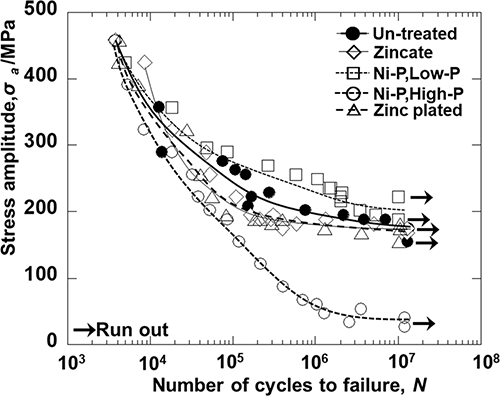
Relation between stress amplitude (σ a) and number of cycles to failure (N) for the un-treated, zincate-treated, Ni-P low-P and high P plated and zinc plated specimens.