
Metallurgical Abstracts on Light Metals and Alloys vol. 58
Atomistic simulation of Guinier–Preston zone nucleation kinetics in Al–Cu alloys: A neural network-driven kinetic Monte Carlo approach
Heting Liao1,2, Jun-Ping Du1, Hajime Kimizuka3 and Shigenobu Ogata1
1 Department of Mechanical Science and Bioengineering, Osaka University
2 Research Center for Structural Materials, National Institute for Materials Science
3 Department of Materials Design Innovation Engineering, Nagoya University
[Published in Computational Materials Science, Vol. 251 (2025), pp. 113771-1-7]
https://doi.org/10.1016/j.commatsci.2025.113771
E-mail: kimizuka[at]nagoya-u.jp
Key Words: Precipitation kinetics, Guinier–Preston zones, Aluminum alloys, Neural network, Atomistic simulation
The kinetic Monte Carlo (kMC) method is employed to simulate time-dependent precipitation nucleation via vacancy jumps during alloy aging. Unlike pure metals, the activation energy for vacancy jumps in alloy systems depends on the local chemical structure, and needs to be recalculated at each kMC step. Traditionally, approximated activation energies derived from that of pure metal and the energy difference before and after the vacancy jump are used, however, they lack quantitative reliability. This study developed a neural network (NN) for face-centered cubic Al–Cu alloys to predict activation barriers based on local chemical structures, significantly accelerating barrier estimation compared to on-the-fly nudged elastic band analyses. NN-based kMC simulations revealed single-layer and double-layer Guinier-Preston (GP) zone formation in Al–2.0 at%Cu alloys. The incubation times of GP zones at 300 and 350 K were quantitatively determined, showing good agreement with experimental observations.
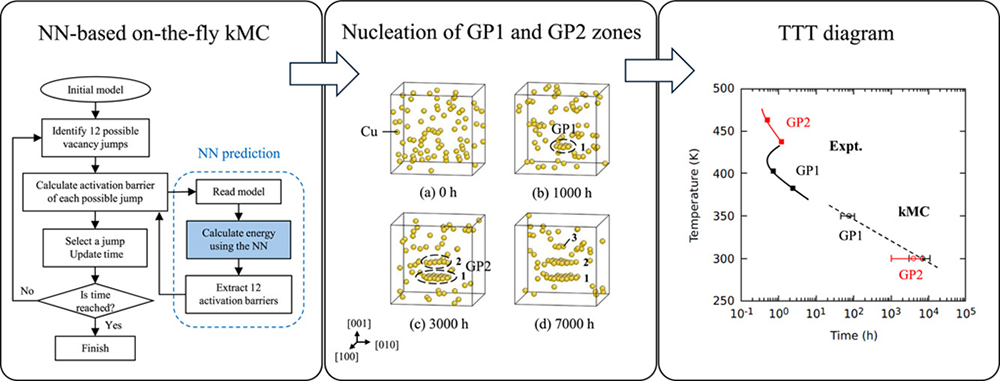
Neural network-based kinetic Monte Carlo simulations for GP-zone nucleation in Al–Cu alloys and the corresponding time-temperature-transformation diagram.