
Metallurgical Abstracts on Light Metals and Alloys vol. 58
Liquid Phase Sintering of Al Powder Using Al-X (X=Cu, Ca, Mg) Eutectic Alloy Powders: Effect of Alloy Elements and Oxide Film Thickness
Ryotaro Kusunoki*, Hideaki Hayashi*, Erika Matsumoto*, Asuka Suzuki*, Naoki Takata*, Makoto Kobashi*, Akira Yoshida**, Takahiro Hamada** and Moe Mekata**
* Graduate School of Engineering, Nagoya University
** Nissan Motor Co., Ltd.
[Published in Materials, Vol. 18 (2025), pp. 1755 (20 pages)]
https://doi.org/10.3390/ma18081755
E-mail: kobashi.makoto.s2[at]f.mail.nagoya-u.ac.jp
Key Words: pressure-less liquid phase sintering; aluminum powder; eutectic alloy; oxide film; additive manufacturing
Sinter-based additive manufacturing (AM) requires sintering for the densification of green bodies. Al powder is difficult to sinter due to the dense oxide film on the surface, and it is difficult to apply to sinter-based AM. Liquid phase sintering using Al-based eutectic alloy powder is promising for sintering Al powder without external pressure. In this study, Al powders with various oxide film thicknesses were sintered using Al-X eutectic alloy powders (X=Cu, Ca, and Mg) to clarify suitable alloy elements in the sintering aids for the liquid phase sintering. When an as-supplied Al powder with an oxide film thickness of approximately 2 nm (presumably amorphous Al2O3 film) was used, Al-Cu and Al-Ca aids promoted the densification, whereas numerous pores were observed in the sample sintered using Al-Mg aid. The pores would be formed during the cooling after sintering, along with the homogenization of Mg distribution. When Al powder with an oxide film thickness of around 4 nm was used, a high relative density of over 95% was maintained using Al-Cu aid, whereas the relative density of the sample sintered using Al-Ca aid significantly degraded, presumably due to the formation of Ca-based oxide. These results indicate that the Al-Cu eutectic alloy powder is a promising sintering aid for the liquid phase sintering of Al powder.
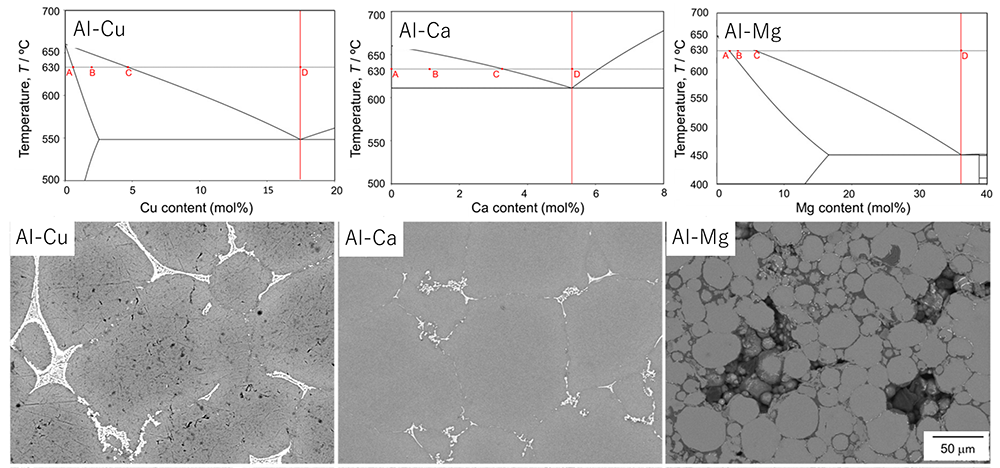
Equilibrium phase diagrams for Al-Cu, Al-Ca, and Al-Mg binary systems, and SEM images showing the microstructure of the samples sintered using aluminum powder oxidized at 400°C, 450°C, and 550°C for 10.8 ks of Al-Cu alloy powders.