
Metallurgical Abstracts on Light Metals and Alloys vol. 58
High-temperature strength and kink-band formation in mille-feuille-structured Ti/FeTi eutectic alloys
Toko Tokunagaa, Takuya Yonemuraa and Koji Hagiharaa,b
a Department of Physical Science and Engineering, Nagoya Institute of Technology, Gokiso, Nagoya, Aichi 466-8555, Japan
b Division of Materials and Manufacturing Science, Graduate School of Engineering, Osaka University, 2-1, Yamadaoka, Suita, Osaka 565-0871, Japan
[Published in Materials Science and Engineering A, Vol. 900 (2024), pp. 146505]
https://doi.org/10.1016/j.msea.2024.146505
E-mail: hagihara[at]nitech.ac.jp
Key Words: Deformation-kink band; Titanium alloy; Plastic deformation; Mille-feuille microstructure; High-temperature strength
To develop ultrahigh-strength and lightweight structural materials, the temperature dependence of the deformation behavior of Ti/FeTi eutectic alloys was examined using compression tests. An extremely high yield stress of ~2.3 GPa was obtained at room temperature accompanied by ~5% of plastic strain by the alignment of a “flower-like” lamellar microstructure. High stress was maintained up to 400°C; however, the yield stress considerably decreased to ~0.8 GPa at 600°C. Shear deformation was observed at room temperature. However, at high temperatures, at 600°C and above, the formation of a deformation-kink band was observed for the first time as the deformation mechanism, and this resulted in a rapid decrease in yield stress. The introduction of primary β-Ti grains in the eutectic microstructure improved the ductility at low temperatures, which was only accompanied by the marginal decrease in yield stress to ~1.9 GPa. Furthermore, the high-temperature strength of the hypoeutectic alloy at 600°C showed a higher value of ~1.0 GPa compared to that in eutectic alloys. The refinement of the colony microstructure of the hypoeutectic alloy suppressed the formation of kink bands. The experimental results suggest that microstructural control is extremely important for improving the high-temperature strength of Ti/FeTi eutectic alloys by increasing the formation stress of the kink bands.
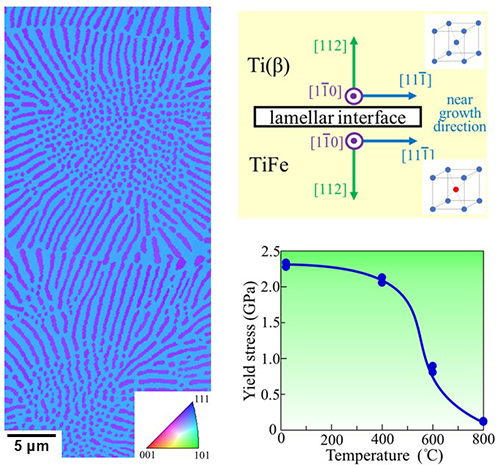
Unique “flower-like” lamellar microstructure, and schematics explaining the orientation relationship between β-Ti and B2-FeTi. Temperature dependence of the yield stress in compression tests is also displayed.