
Metallurgical Abstracts on Light Metals and Alloys vol. 58
Mechanism of ductility change in Al-10.44Si-0.25Mg-0.71Mn-0.25Fe die-cast alloy by short time heat treatment
Shogo Furuta*, Daiki Miake*, Isao Akuzawa**, Shunzo Aoyama**, Nobuyuki Sakai**, Masakazu Kobayashi* and Hiromi Miura
* Department of Mechanical Engineering, Toyohashi University of Technology
** Ahresty Corporation
[Published in J.JFS, Vol. 97 (2025), pp. 369-379]
https://www.jstage.jst.go.jp/article/jfes/97/6/97_369/_article/-char/en
E-mail: m-kobayashi[at]me.tut.ac.jp
Key Words: brief heat treatment, microstructural evolution, ductility, aluminum alloy, die casting
Mechanical joining methods such as self-piercing riveting (SPR) are used to joint iron-based and aluminum alloy parts. However, low-ductility aluminum die-cast alloy often results in cracking and insufficient quality. Therefore, a method has been proposed to locally recover ductility and prevent cracking while maintaining overall strength by rapidly heating and briefly heat-treating the joint area using a laser or similar tool. This study aims to investigate the mechanical properties and microstructural changes in Al-Si-Mg-Mn-Fe die-cast alloys subjected to rapid heating and short-time heat-treatment, focusing on the mechanism of ductility changes. After rapid heating and short-duration heat treatment, the eutectic Si particles became more spherical as the heat treatment temperature increased. An exothermic peak at 510 K in DSC disappeared after the heat-treated samples. SEM and TEM observations showed no precipitates in the as-cast α-Al phase, but precipitates of Si were confirmed after the heat treatment. This suggests that Si was supersaturated in the α-Al phase in the as-cast state. The precipitation of Si in the α-Al phase contributed little to strength but suggested improvement of ductility. Synchrotron multi-scale tomography showed no significant changes in casting defects or intermetallic compounds due to the heat treatment, suggesting that they have a little effect on change of ductility. Therefore, the primary factors contributing to increased ductility of aluminum die-cast alloy after the heat treatment are stress concentration relaxation due to the spheroidization of eutectic Si particles and reduced connectivity of Si particles.
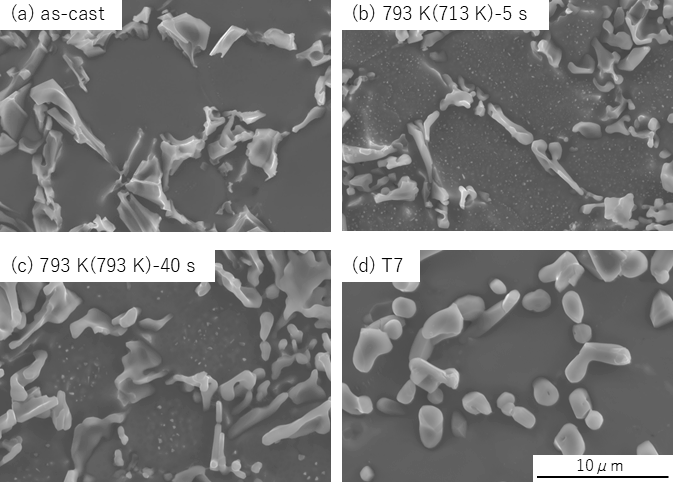
SEM observation of eutectic Si particles by deep etching in Al-10.44Si-0.25Mg-0.71Mn-0.25Fe die-cast alloy: The elongations to fracture were (a) 6.87 %, (b) 11.7 %, (c) 20.3 % and (d) 21.9 %, respectively. Microstructural changes can be found.