
Metallurgical Abstracts on Light Metals and Alloys vol. 58
Fabrication of Carbon-doped TiO2 Layers via Ti Oxidation and Evaluation of their Antibacterial Activity
Ryusuke Koizumi*, Kyosuke Ueda*, Koyu Ito**, Kouetsu Ogasawara** and Takayuki Narushima*
* Department of Materials Processing, Graduate School of Engineering, Tohoku University
** Department of Immunobiology, Institute of Development, Aging and Cancer, Tohoku University
[Published in Proc. the 15th World Conference on Titanium (Ti-2023), Chapter 3: Biomedical & Healthcare Applications, pp. 46-49]
E-mail: takayuki.narushima.c3[at]tohoku.ac.jp
Key Words: Visible-light response, photocatalysis, carbon, titanium dioxide, biomedical
The visible-light-responsive photocatalytic activity of TiO2 has the potential to facilitate the antibacterial functionalization of dental implants. In this study, TiO2 layers were fabricated on commercially pure (CP) Ti substrates using a two-step thermal oxidation process involving carbonization (1st step), followed by oxidation (2nd step). The anatase fraction of the TiO2 layers decreased with increasing 2nd-step temperature. In the 2nd step, carbon was introduced into the TiO2 layer by optimizing 2nd-step temperature. The carbon-doped TiO2 layers exhibited antibacterial activity against Escherichia coli under short-duration visible-light irradiation (15 min). The carbon introduced into the TiO2 layer contributes to its visible-light response by decreasing its bandgap energy. Thus, the carbon-doped TiO2 layer has the potential for the antibacterial functionalization of the Ti surface.
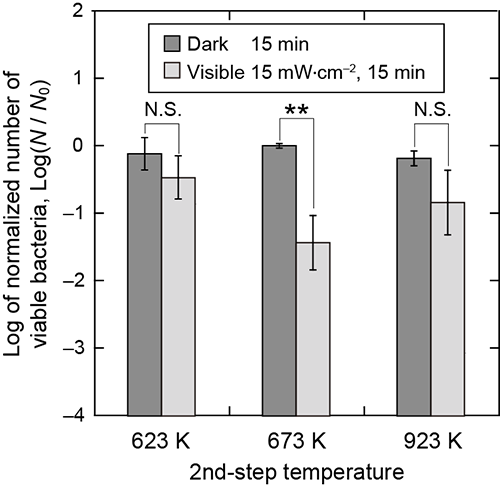
Logarithm of the normalized number of viable bacteria on the TiO2 layers formed at the 2nd-step temperatures of 623, 673, and 923 K after visible-light irradiation or placement in the dark for 15 min. (** p < 0.01)