
Metallurgical Abstracts on Light Metals and Alloys vol. 58
Preparation of Polymer Nanopillar Arrays with Wettability Gradients by Nanoimprinting Using Anodic Porous Alumina Molds
Misaki Uchimura and Takashi Yanagishita
Department of Applied Chemistry, Tokyo Metropolitan University
[Published in Langmuir, Vol. 41 (2025), p. 16391]
https://doi.org/10.1021/acs.langmuir.5c01679
E-mail: yanagish [at]tmu.ac.jp
Key Words: Anodic porous alumina, gradient structure, droplet transport
A polymer nanopillar array with continuously varying diameter was fabricated by nanoimprinting with an anodic porous alumina mold with a continuously varying pore size. When the contact angle of the water droplets on the obtained polymer nanopillar array was measured, it was confirmed that the wettability changed continuously with the diameter of the nanopillars. It was also observed that water droplets that formed on the surface of a polymer nanopillar array with continuously varying diameter spontaneously moved. The results of measuring the contact angles of water droplets on the surfaces of the nanohole and nanopillar array structures showed that the relationship between surface porosity and contact angle was similar for both surfaces. When the range of change in the contact angle of a water droplet and the length of the gradient structure were matched on a wettability gradient surface fabricated using a nanopillar array and a nanohole array, it was found that the spontaneous transport distance of a water droplet formed on the nanopillar array was longer than that of a water droplet formed on the nanohole array. We believe that this is because of the difference in dynamic contact angle between the surfaces of the structures.
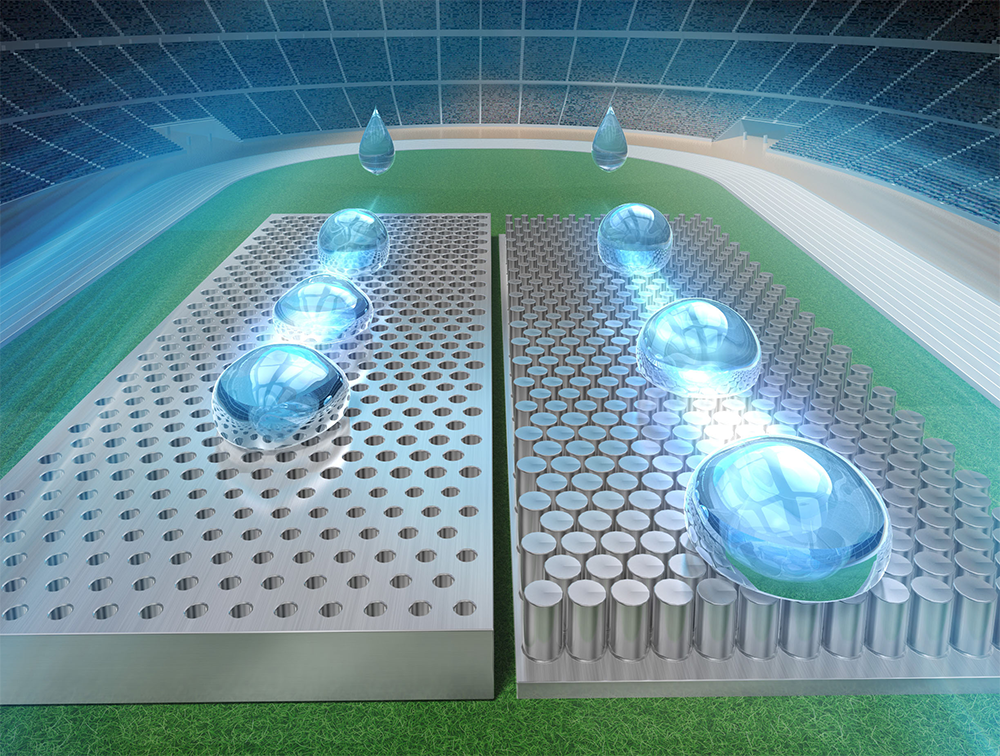
Schematic comparing nanohole arrays and nanopillar arrays in spontaneous movement of water droplets.