Metallurgical Abstracts on Light Metals and Alloys vol. 58
Effect of mechanical properties of worked material and roller axial position in twist rolling
Yutaro Ogura1, Kazuyuki Shiobara1, Shohei Kajikawa2, Takahiro Makiyama3 and Takashi Kuboki2
1 Department of Mechanical Systems Program, The University of Electro-Communications
2 Department of Mechanical and Intelligent Systems Engineering, The University of Electro-Communications
3 Department of Information Science and Mechatronics Engineering, Institute of Technologists
[Published in International Conference on Materials Processing Technology 2025, MF_4, pp. 88-91]
E-mail: kuboki[at]mce.uec.ac.jp
Key Words: twist rolling, roll axial position, springback
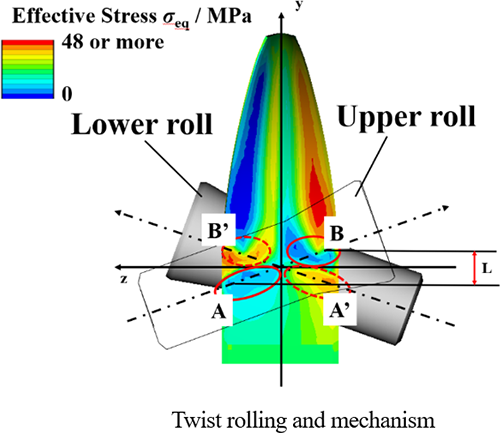
The twist rolling method was proposed as a new method for manufacturing twisted metal sheets for turbine blades and propellers. Twist rolling is a method of continuously twisting and forming metal sheets using tapered rollers. In this study, four types of metals, AA1050-H24, AA1050-O, AA5052-H24, and SPCC, were compared, and the effects of the mechanical properties of the rolled material on the deformation and the axial position of the roll on the forming shape were investigated experimentally and analytically by finite element method (FEM) analysis. The experimental and analytical results show that the torsional angle can be adjusted by the roll axial position regardless of the material properties of the rolled material. In addition, twist rolling was applicable regardless of studied material, and the effect of roll position were qualitatively consistent. When the ratio of flow stress to elastic modulus was small, the torsional angle decreased due to springback that occurred during processing. FEM results also suggested the possibility of suppressing springback by increasing the rigidity of the rollers.