Metallurgical Abstracts on Light Metals and Alloys vol. 58
Crystal plasticity-based forming limit analysis for two types of 5052 aluminum alloy sheets with different heat treatment conditions
Sho Sato1, Maya Tsukamoto1, Yasuhiro Maeda2, Yasushi Maeda2 and Takayuki Hama1
1 Graduate School of Energy Science, Kyoto University, Japan
2 Technical Development Group, KOBE STEEL, LTD., Kobe 651-2271, Japan
[Published in Materials Research Proceedings, Vol. 41, (2024), pp. 1009-1016]
https://doi.org/10.21741/9781644903131-111
E-mail: hama[at]energy.kyoto-u.ac.jp
Key Words: Crystal-plasticity analysis, Forming limit diagram, Aluminum alloy, Nakajima test, Marciniak-Kuczyński analysis
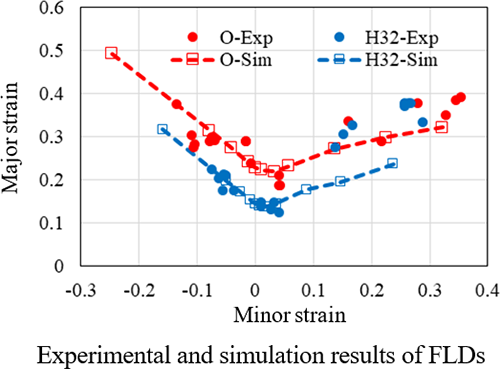
5000 series Al alloy sheets are increasingly applied to press forming products, such as components used in railroad vehicles and some automobiles, due to their advantages of high specific strength and good corrosion resistance. However, in press forming processes, forming defects, such as failure and wrinkles, often appear. Therefore, it is essential to understand the formability of sheet materials under various stress states and to design appropriate processes to prevent forming-defects occurrence. To evaluate occurrence of failure under various strain states, a Forming Limit Diagram (FLD) is widely used. Although the effects of texture and work-hardening behavior of materials on FLD have been widely studied, their experimental validations are not sufficient. In this study, A5052-O and -H32 Al alloy sheets, which have similar texture and show different work-hardening behavior, are used to investigate the effect of work hardening on the FLD. In the FLDs obtained experimentally, the limit strain under plane-strain tension was larger in the A5052-O sheet with larger work hardening than that of the A5052-H32 sheet with smaller work hardening, whereas that under equibiaxial tension was similar in the two sheets. These trends were reproduced qualitatively well by crystal-plasticity forming limit analyses. The mechanism that yielded these trends were discussed using the simulation results.