
Metallurgical Abstracts on Light Metals and Alloys vol. 58
Enhancing the precipitation hardening ability of Al-Mg-Ga-In-Sn alloy through low-temperature aging treatment
Myeong-heom Park1, Daisuke Terada1,2, Manuel Marya3 and Nobuhiro Tsuji1
1 Department of Materials Science and Engineering, Kyoto University, Yoshida Honmachi, Sakyo-ku, Kyoto 606-8501, Japan
2 Department of Materials Science and Engineering, Chiba Institute of Technology, Tsudanuma, Narashino, Chiba 275-0016, Japan
3 Enabling Technologies, SLB, 200 Gillingham Road, Sugarland, TX 77478, USA
[Published in Journal of Alloys and Compounds, Vol. 1014 (2025), 178669]
https://doi.org/10.1016/j.jallcom.2025.178669
E-mail: nobuhiro-tsuji [at] mtl.kyoto-u.ac.jp
Key Words: Aluminum alloy, Hydraulic fracturing, Aging, Mechanical properties, Precipitation hardening,
Coherent precipitates, High-strength aluminum
An experimental as-cast Al-Mg-Ga-In-Sn alloy, with unique combinations of high-strength, dissolvability, and manufacturability, has been developed as a structural oilfield material for hydraulic fracturing. The present study reports an exceptional aging hardening ability in which the Al-Mg-Ga-In-Sn alloy reached ~180 HV through aging between 80°C and 120°C. This significant hardening response has been attributed to dynamic changes in the precipitation. TEM observation and diffraction pattern analysis revealed that the as-cast specimen with a hardness of 142 HV exhibited numerous ~ 7 nm fine precipitates, which were identified as MgGa2 and Mg2Ga5. Low-temperature aging, which led to a higher hardness of ~180 HV, resulted in the formation of L12-type coherent precipitates with an average size of about 3 nm. In contrast, only incoherent precipitates MgGa2 and Mg2Ga5 with relatively large sizes of 6.5 nm to 14.2 nm were observed after aging between 170°C and 300°C, resulting in a major reduction in hardness. The present study also explored the precipitate evolution, progressing from L12-type coherent precipitates to stable incoherent precipitates of MgGa2 and Mg2Ga5 during over-aging treatment at a low temperature. As these experimental as-cast specimen exhibited limited tensile properties due to brittle grain boundary phases, potential improvements are discussed for a greater use of such alloys beyond its historical use, largely through controlled reduction in alloying and improved processing over solely an as-cast condition.
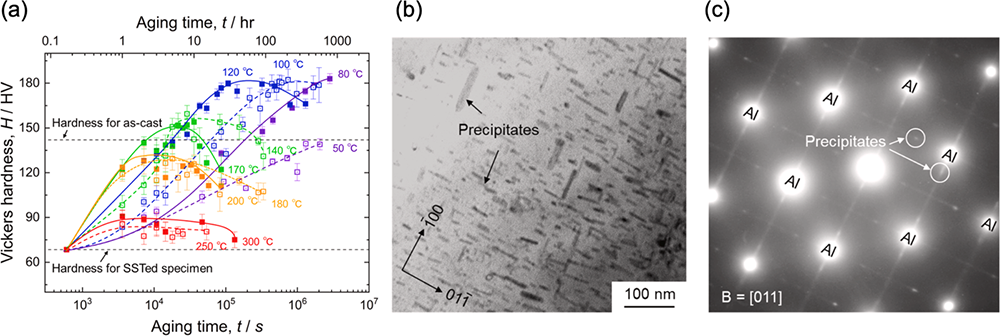
(a) Hardness evolution of the Al-Mg-Ga-In-Sn alloy through aging treatments at various temperatures ranging from 50°C to 300°C following solid-solution treatment (SST) at 500°C for 3 hr. The upper and lower horizontal dashed lines indicate the average Vickers hardness values of the as-cast and SSTed specimens, respectively. (b) TEM microstructure and (c) corresponding selected area diffraction (SAD) pattern of the Al matrix in the as-cast specimen, observed from [011] Al direction. In the SAD pattern, Al-corresponding spots were indexed, and precipitate-corresponding spots were indicated with circles.