
Metallurgical Abstracts on Light Metals and Alloys vol. 58
Long-term reliability of high-zinc Al-Zn-Mg-Cu alloys against stress corrosion cracking
Zhengkai Wu*, Hiroyuki Toda*, Hiro Fujihara*, Jianwei Tang*, Akihisa Takeuchi** and Masayuki Uesugi**
* Department of Mechanical Engineering, Kyushu University
** Japan Synchrotron Radiation Research Institute
[Published in Engineering Failure Analysis, Vol. 182, Part A (2025), 110002]
https://doi.org/10.1016/j.engfailanal.2025.110002
E-mail: toda[at]mech.kyushu-u.ac.jp
Key Words: Aluminium alloy, Stress corrosion cracking, Hydrogen embrittlement, Anodic dissolution, Hydrogen trapping
High-zinc-content Al-Zn-Mg-Cu alloys exhibit excellent mechanical strength but suffer from severe stress corrosion cracking (SCC), limiting their long-term structural reliability. In this study, a modified Al-Zn-Mg-Cu alloy (designated as T+Mn alloy) was developed by adding Mn to promote Mn-rich dispersoids and applying high-temperature aging to introduce T-phase precipitates, aiming to suppress SCC. Standardized C-Ring testing revealed that the SCC lifetime of the T+Mn alloy was 1–2 orders of magnitude longer than that of the conventional η-phase alloy. The η alloy exhibited intergranular cracking (IGC) and quasi-cleavage fracture (QCF), driven by grain boundary corrosion and hydrogen accumulation, whereas the T+Mn alloy showed delayed crack initiation and QCF-dominated propagation. These improvements were attributed to reduced anodic dissolution and hydrogen redistribution toward benign trap sites. The findings establish a microstructural design strategy to enhance the long-term SCC resistance of high-strength aluminum alloys.
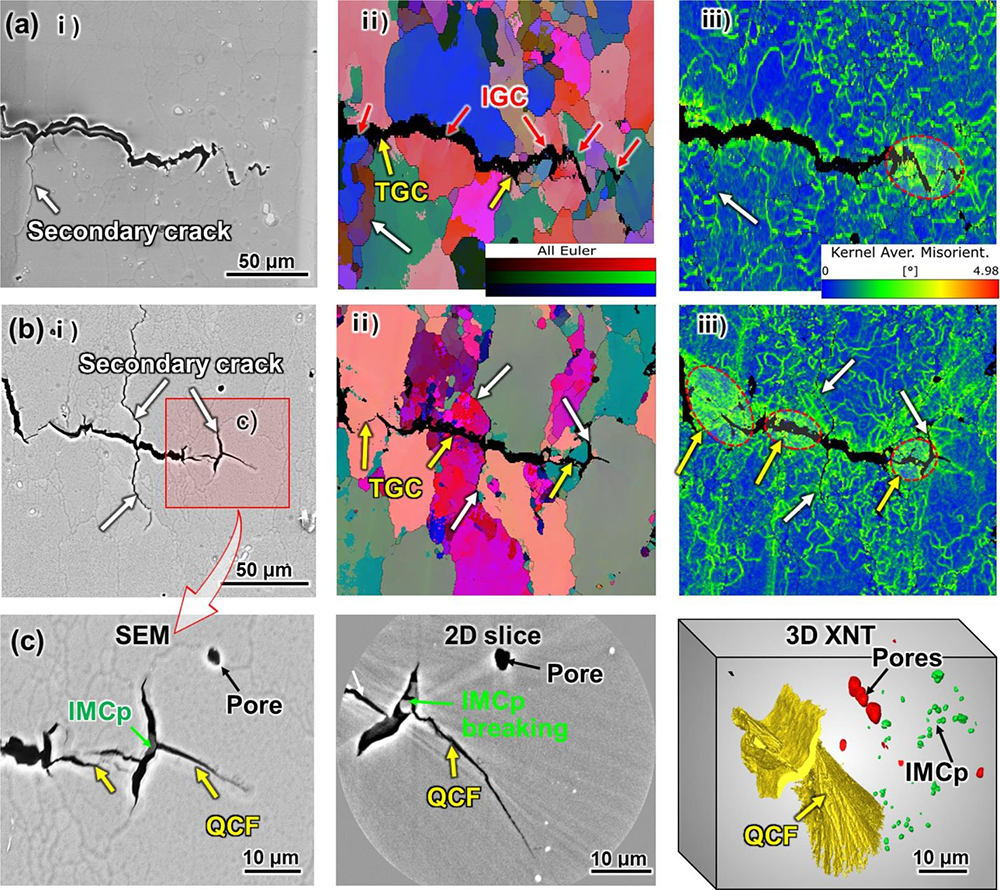
SCC crack propagation in (a) η and (b) T+Mn alloys: (i) SEM images showing cracks; (ii) EBSD showing IGC and TGC; (iii) KAM maps representing localized strain. (c) Multimodal characterization at the crack tip.