
Metallurgical Abstracts on Light Metals and Alloys vol. 58
Surrogate model-based assessment of particle damage behaviour of Al-Zn-Mg alloy
Hiroyuki Toda1, Yuki Fukuda1, Han Li2, Kyosuke Hirayama1,3, Hiro Fujihara1, Kazuyuki Shimizu4,
Yafei Wang1, Jianwei Tang1, Akihisa Takeuchi5 and Masayuki Uesugi5
1 Department of Mechanical Engineering, Kyushu University
2 College of Informatics, Huazhong Agricultural University
3 Department of Materials Science and Engineering, Kyoto University
4 Department of Physical Science and Materials Engineering, Iwate University
5 Japan Synchrotron Radiation Research Institute
[Published in Acta Materialia, Vol. 281 (2024), 120391]
https://doi.org/10.1016/j.actamat.2024.120391
E-mail: toda[at]mech.kyushu-u.ac.jp
Key Words: Surrogate modelling, Microtomography, Hydrogen embrittlement, Dispersion particles, Al-Zn-Mg alloys
Recent research has found some particles with even stronger hydrogen trapping capacity than precipitates that are reported to be the origin of hydrogen embrittlement. Such particles can reduce hydrogen concentration at the interface between the precipitates and aluminium by absorbing hydrogen in their interiors, thus preventing the hydrogen embrittlement. However, this cannot be achieved if the particles, which have absorbed large amounts of hydrogen, are damaged due to hydrogen embrittlement. In this study, the hydrogen embrittlement of aluminium was observed in situ by X-ray CT, and the damage behaviour was analysed of all the particles. After exhaustive quantification of the size, shape, and spatial distribution of the particles, coarsening processes identified highly correlated design variables. Subsequently, particle damage behaviour was analysed utilizing a surrogate model using a support vector machine. The damage to particles could be described only by design variables representing size and shape, while those representing spatial distribution were removed through the coarsening processes. No change was observed in the damage behaviour particles with increasing hydrogen concentrations, and it was concluded that the dispersion of particles is effective in preventing hydrogen embrittlement.
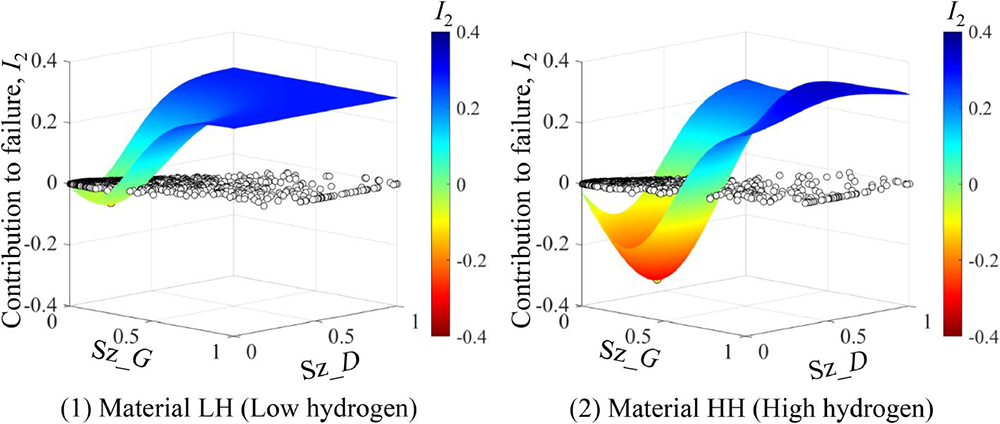
3D contour maps of the objective function I2 predicted by the surrogate model are shown. The effects of hydrogen concentrations are shown for Al7Cu2Fe particles.