
Metallurgical Abstracts on Light Metals and Alloys vol. 58
Electrical Conductivity (Resistivity) Measurement of ω Titanium
Masaki Mito1, Kosuke Fukunaga1, Norimasa Nishiyama2, Kaishi Naragino3, Hiromoto Kitahara4, Takahiro Masuda1 and Zenji Horita1,4,5
1 Graduate School of Engineering, Kyushu Institute of Technology, Kitakyushu 804-8550, Japan
2 Laboratory for Materials and Structures, Tokyo Institute of Technology, Yokohama 226-8503, Japan
3 Graduate School of Science and Technology, Kumamoto University, Kumamoto 860-8555, Japan
4 Magnesium Research Center, Kumamoto University, Kumamoto 860-8555, Japan
5 Synchrotron Light Application Center, Saga University, Saga 840-8502, Japan
[Published in Materials Transactions, Vol. 66, (2025) 561-568]
https://doi.org/10.2320/matertrans.MT-MC2024012
E-mail: mitoh[at]mns.kyutech.ac.jp
Key Words: high-pressure phase, electrical conductivity, titanium
We measured the electrical conductivity and Vickers microhardness for ω phase in pure titanium (Ti), which was produced by a high-pressure synthesis. The results are compared with those of 100% α phase and of the samples processed by high-pressure torsion (HPT). The contactless type of electrical conductivity measurement using a superconducting quantum interference device magnetometer allows the measurement over a wide range of temperature down to the liquid helium temperature. Vickers microhardness measurement is conducted for the ω phase under different applied loads to minimize the effect of reverse transformation from the ω phase to the α phase during the measurement. This difference in the microstructure results in appreciably lower electrical conductivity in a temperature range below 3100K for the HPT-processed sample. We could observe no superconducting anomaly in the ω phase down to the temperature of 1.8 K, suggesting that a superconductive state does not exist at ambient pressure above 1.8 K.
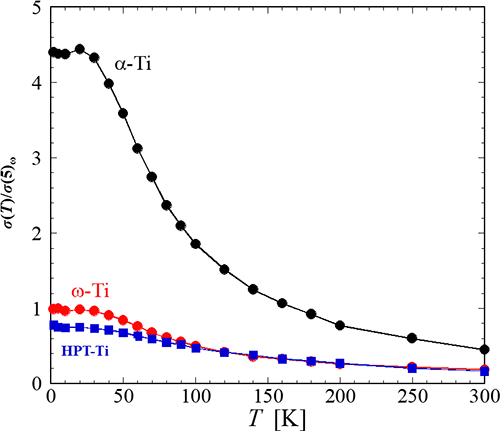
Temperature dependence of relative electrical conductivity. σ (5 K)ω is electrical conductivity of ω phase of titanium at 5 K.