Metallurgical Abstracts on Light Metals and Alloys vol. 58
Highly Efficient Coral Propagation using Titanium and Regenerative Medicine Techniques
Masato Ueda*,**,***, Nanako Kosaka****, Tomoyuki Takahashi***** and Masahiko Ikeda******
* Department of Chemistry and Materials Engineering, Kansai University
** Kansai Univ. Carbon Neutrality Research Centre
*** Innoqua Inc.
**** Graduate School of Science and Engineering, Kansai University
***** Faculty of Societal Safety Sciences, Kansai University
****** Nihon Superior Co., Ltd.
[Published in F1000Research, Proc. of 15th World Conference on Titanium (Ti-2023) (2024)]
https://f1000research-files.f1000.com/posters/compressed/f1000research-680680.pdf#page=42
E-mail: m-ueda[at]kansai-u.ac.jp
Key Words: bone formation, CP-Ti, TiO2, surface modification, polyps
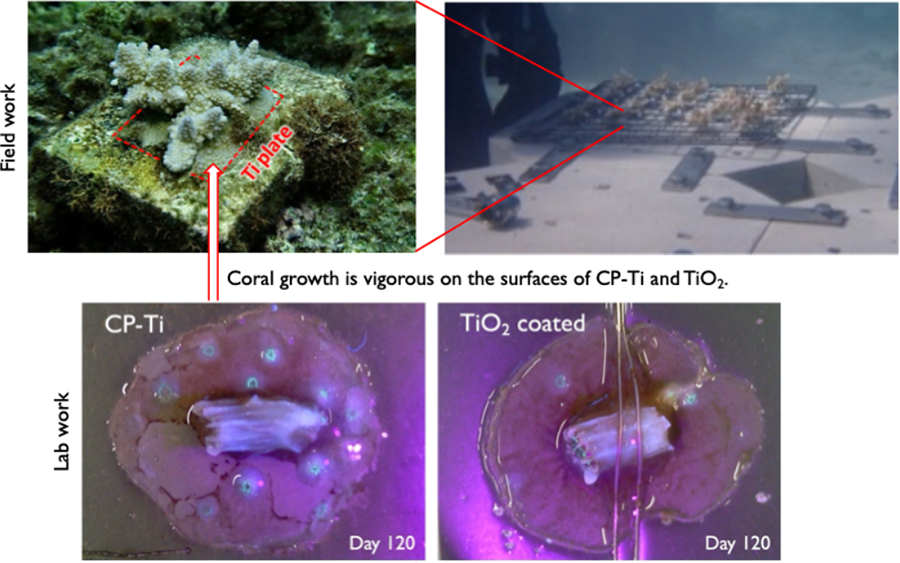
Roughly one-quarter of coral reefs worldwide are already damaged beyond repair, and another two-thirds are under serious threat. Several coral restoration techniques such as fragmentation, farming, and Biorock have been developed and implemented in recent years. In vertebrates like mammals, osteoblasts form bone composed of hydroxyapatite. Similarly, in hard corals, polyps build skeletons of calcium carbonate, and the mechanisms of formation are almost identical despite the different substances. Titanium (Ti) and its alloys are widely used as biomaterials for orthopaedic and dental implants because their surfaces, known to be titanium dioxide (TiO2), can promote osteoconduction after suitable modification. The purpose of this work was to investigate the potential of Ti and TiO2 as scaffolds for immobilising polyps. The corals (Pocillopora damicornis sp., imported from Australia) were divided into fragments of about 5 mm. The fragments were placed in a tank with artificial seawater to separate the polyps from the skeleton. The obtained polyps were then seeded on the substrates. The separated polyps preferentially adhered to the TiO2 surface and expanded vigorously. Interfacial analysis between the polyps and substrates was carried out using a Quartz Crystal Microbalance to understand the adhesion process. Up to 8 hours after seeding, the resonant frequency decreased and resistance increased, confirming that the adhesion and expansion of the polyps on the substrates could be detected.