
Metallurgical Abstracts on Light Metals and Alloys vol. 58
Temperature dependence of deformation mechanisms and its effects on the mechanical properties of commercial-purity titanium sheets with different grain sizes
Chihiro Watanabe*, Taisuke Nakamura**, Hiroki Iwanuma**, Norimitsu Koga*, Tomotsugu Shimokawa*, Yojiro Oba***, Masakazu Kobayashi*** and Hiromi Miura***
* Faculty of Mechanical Engineering, Kanazawa University
** Graduate Student, Division of Mechanical Science and Engineering, Kanazawa University
*** Department of Mechanical Science and Engineering, Toyohashi University of Technology
[Published in Materials Science and Engineering, Vol. 943 (2025), 148765]
https://doi.org/10.1016/j.msea.2025.148765
E-mail: chihiro[at]se.kanazawa-u.ac.jp
Key Words: Commercial-purity titanium, Multi-directional forging, Ultrafine grain, Slip deformation, Twinning
Ultrafine-grained (UFGed) Grade 2 commercial-purity titanium sheets were fabricated by thermomechanical treatments, including multi-directional forging and cold rolling. Thereafter, a portion of these UFGed sheets was annealed under different conditions to prepare specimens with three different average grain sizes (0.07, 0.8, and 12 µm). Further, these specimens were subjected to tensile tests at room temperature (RT) and cryogenic temperature of 77 K. The experimental results revealed different temperature dependences of deformation behaviors depending on grain size. At 77 K, independent of grain size, all the specimens exhibited much higher 0.2% proof stress, ultimate tensile stress and elongation to failure than at RT. Microstructural analysis revealed that prismatic <a> slip was the dominant deformation mechanism in all specimens, with pyramidal <c + a> slip also activated in the UFGed and fine-grained CP-Ti. Twinning was negligible in these specimens at RT but the deformation at 77 K significantly stimulated twins, particularly {11-22} <11-2-3> compression twins. Meanwhile, the coarse-grained CP-Ti exhibited twinning even at RT. Still more, mechanical twinning was much more favored at 77 K. Finally, it was concluded that uniform deformation induced by mechanical twinning effectively contributed to larger ductility at 77 K to improve strength–ductility balance. The findings indicate that mechanical twinning, rather than slip activity, is the primary factor governing the temperature dependence of mechanical properties of CP-Ti.
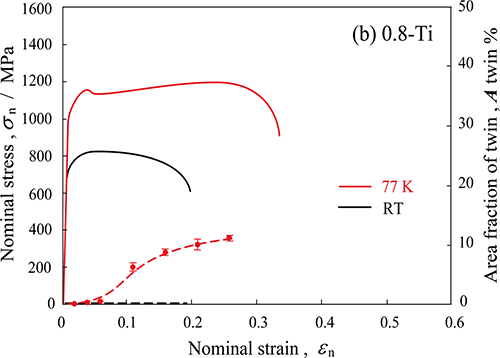
Stress-strain curves and area fraction of deformation twins of CP-Ti with a grain diameter of 0.8 µm. Twin fraction markedly increased as temperature decreased, which significantly enhanced elongation due to TWIP effect.