Metallurgical Abstracts on Light Metals and Alloys vol. 58
The Effects of Pyridine Derivatives as Additives on Surface Brightness of Aluminum Films Electrodeposited from an AlCl3-EMIC-Toluene Bath: Correlation between Molecular Structure of Additives and Surface Brightness
Futoshi Matsumoto*, Masayuki Yanagi*, Hidenori Matsuzawa** and Mika Fukunishi*
* Department of Applied Chemistry, Kanagawa University
** Department of Applied Chemistry, Chiba Institute of Technology
[Published in Material Science and Technology of Japan, 61(2024), pp. 229-234]
https://www.mssj.or.jp/zk/zk_backno/J61/no6/v61n6p229.pdf
E-mail: fmatsumoto[at]kanagawa-u.ac.jp
Key Words: Aluminum deposition, additive, ionic liquid, ab initio molecular orbital calculations
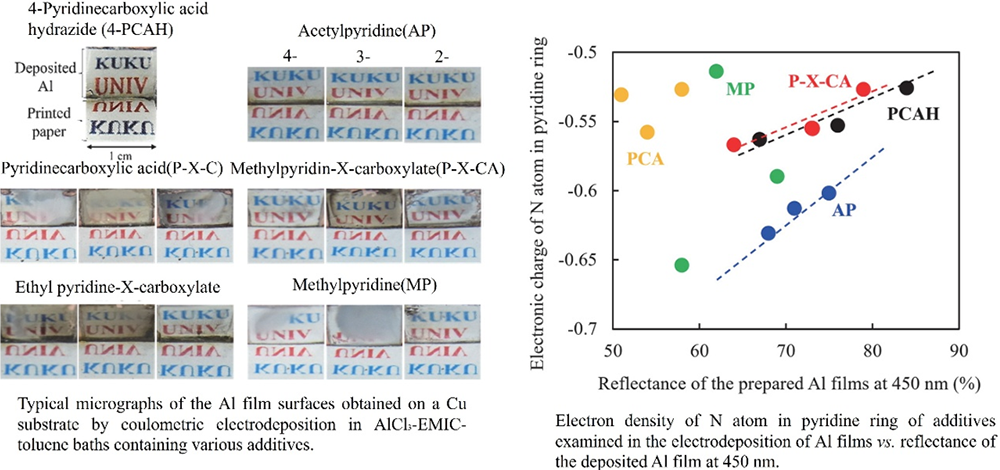
The effects of additives on the surface brightness of Al films electrodeposited on Cu substrates from AlCl3-ethyl-3-methylimidazolium chloride (EMIC)-toluene ionic liquid bath were investigated for pyridine derivatives as additives in which various functional groups were introduced. The surface brightness of the electrodeposited Al films was measured as the reflectance at 450 nm. For a given series of structural isomers, the steric hindrance effects of the functional groups introduced into pyridine rings on the surface brightness was observed, i.e., meta- and ortho-isomers gave smaller reflectance than para- isomers. It was found that the surface brightness of the deposited Al films can be, though roughly, related to the electron density of N atom of pyridine ring which was evaluated by ab initio molecular orbital calculations, i.e., the lower the electron density of the N atom, the higher the surface brightness. The results obtained suggested that the active center of the additives for adsorption to the electrode surface might be the N atom of the pyridine ring and that the additive with a lower electron density of N atom in pyridine ring adsorbs more strong on the electrode surface, which moderately hinders a growth of Al nuclei, resulting in very fine particles with sizes in the nanometer range and as a result the Al film with a higher surface brightness is obtained.