
Metallurgical Abstracts on Light Metals and Alloys vol. 58
Using machine learning as a supportive tool to systematically study the tensile properties of a Ti-6Al-2Sn-4Zr-2Mo-Si alloy with various microstructures: effects of texture, phase proportions and grain size
Irvin Séchepée*, Louis Didon**, Lucie Bajic** and Hiroaki Matsumoto*
* Department of Advanced Materials Science, Faculty of Engineering and Design, Kagawa University
** IMT Mines Albi (FRANCE)
[Published in Materials Characterization, Vol. 225 (2025), 115148 (11 pages)]
https://doi.org/10.1016/j.matchar.2025.115148
E-mail: matsumoto.hiroaki[at]Kagawa-u.ac.jp
Key Words: Titanium alloy, Microstructure, Tensile properties, Machine learning
This study investigates the effects of microstructures on the tensile properties of a Ti-6Al-2Sn-4Zr-2Mo-Si alloy with a hot-rolled T-split texture. A statistical approach using machine learning is implemented to support the systematic study for a more quantitative analysis. The comparative study of the tensile properties of equiaxed (α+β), bimodal (α+β), and duplex (α+α') microstructures shows that the duplex (α+α') stands out with the best strength (UTS) – ductility and work hardening – ductility balances. Especially, the duplex (α+α') reveals an outstanding work hardening ability and a great ductility as compared to the equiaxed (α+β) and bimodal (α+β). Through conventional means, the impacts of the different microstructural parameters were qualitatively investigated, and the parameters were ordered from most impactful to less impactful: the type of microstructure (equiaxed, bimodal, or duplex), followed by the orientation of the deformation axis (parallel or perpendicular to the rolling axis), the phase proportion (fraction of primary α), and finally the grain size. Due to the difficulties of accurately measuring such impacts, a machine learning method with a statistical approach to handle small datasets was implemented to understand more quantitatively the roles of the microstructural parameters. Thanks to the SHAP values, the feature importances of the models trained to predict the proof stress (Rp02), ultimate tensile strength (UTS), plastic elongation (Ap%), and work hardening exponent (n) were successfully computed. It turns out the different features were ranked in the same order than during the experimental study.
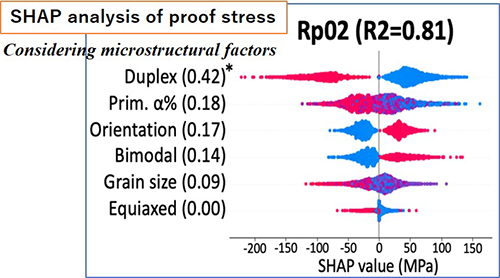
The influence of microstructural factors on the tensile properties (strength, ductility, and work hardening property) of Ti-6242S alloy quantitatively evaluated using machine learning and SHAP analysis.