Metallurgical Abstracts on Light Metals and Alloys vol. 58
Low Young’s modulus in laser powder bed fusion processed Ti-15Mo-5Zr-3Al alloys achieved by the control of crystallographic texture combined with the retention of low-stability bcc structure
Shota Higashino*, Daisuke Miyashita*, Takuya Ishimoto**,***,****, Eisuke Miyoshi*, Takayoshi Nakano**,*** and Masakazu Tane*,**,***
* Graduate School of Engineering, Osaka Metropolitan University
** Division of Materials and Manufacturing Science, Graduate School of Engineering, The University of Osaka
*** Anisotropic Design and Additive Manufacturing Research Center, The University of Osaka, 2-1 Yamadaoka, Suita, Osaka 565-0871, Japan
**** Aluminium Research Center, University of Toyama
[Published in Additive Manufacturing, Vol. 102 (2025), 104720]
https://doi.org/10.1016/j.addma.2025.104720
E-mail: tane[at]mat.eng.osaka-u.ac.jp
Key Words: Laser powder bed fusion, Elastic properties, Titanium alloys, Crystallographic texture, ω phase transformation
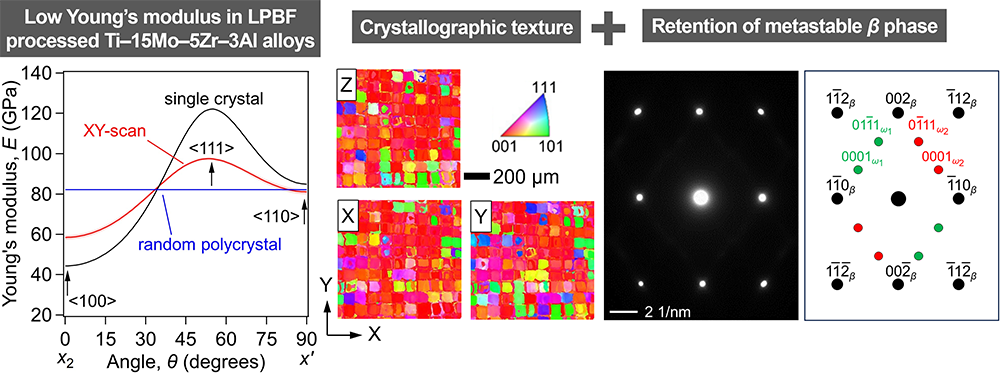
Metastable β (body-centered cubic)-phase Ti alloys, quenched from a high-temperature β-phase field, have attracted great interest as biomedical implants, owing to their low Young’s modulus. Recently, the application of additive manufacturing (AM) to β-phase Ti alloys has gathered much attention, because the AM process can form anisotropic crystallographic texture in which an elastically soft direction is preferentially oriented, resulting in low Young’s modulus in a specific direction. However, the effects of anisotropic texture and microstructure formed by the AM process on anisotropic elastic properties have not been clarified in detail. In the present study, we measured all the independent elastic stiffness components of β-phase Ti-15Mo-5Zr-3Al (mass%) alloys, prepared by bidirectional scanning with (XY-scan) and without (X-scan) an interlayer rotation of 90° in laser powder bed fusion (LPBF), one of the AM processes, using resonant ultrasound spectroscopy. The measurements revealed that the LPBF-processed Ti alloys exhibited strong elastic anisotropy and a low Young’s modulus (below 60 GPa) in the <100>-oriented direction of the alloy prepared by the XY-scan. Furthermore, micromechanics calculations based on Eshelby’s inclusion theory revealed that the single crystal constituting the alloys prepared by LPBF had almost the same elastic stiffness as that of a single crystal prepared by the floating zone melting, which indicated that the metastable β phase was retained by suppressing an easily occurring β- to ω-phase transformation during LPBF. These results indicate that texture control combined with retention of the metastable β phase by LPBF achieves biocompatible low Young’s modulus.