
Metallurgical Abstracts on Light Metals and Alloys vol. 58
On the viability of in-situ alloyed Ti-1Fe as a strong and ductile alternative to Ti-6Al-4V for laser-based powder bed fusion
Jeff Huang*, **, Ammarueda Issariyapat*, Shota Kariya*, Junko Umeda* and Katsuyoshi Kondoh*
* Joining and Welding Research Institution, The University of Osaka
** Graduate School of Engineering, The University of Osaka
[Published in Additive Manufacturing, 105 5 (2025) 104788]
https://doi.org/10.1016/j.addma.2025.104788
E-mail: umeda.juko.jwri[at]osaka-u.ac.jp
Key Words: Titanium, laser powder bed fusion, in-situ alloying, microstructures, mechanical properties
Developments in the additive manufacturing (AM) of titanium have historically centred around the market-leading Ti-6Al-4V alloy, with many studies aimed at adapting the seventy-year-old composition for newer AM processes such as laser-based powder bed fusion (PBF-LB/M). Amongst these studies, PBF-LB/M Ti-6Al-4V is usually shown to be remarkably strong and moderately ductile (if defect free), because of the ultra-fine martensitic α/α’ microstructures produced under the rapid cooling conditions of PBF-LB/M. However, despite these acceptable properties, the use of Ti-6Al-4V in AM fundamentally contradicts the original intention behind the design of this alloy composition, which relies on rare and expensive vanadium solutes to promote α+ β microstructures for good wrought-forming properties. In essence, neither the intended microstructures, nor the intended properties are relevant or compatible with near-net-shape AM processes. Therefore, it seems natural to question the strict adherence to conventional alloys in PBF-LB/M. In search of alternatives, the present study attempts to replicate the microstructures and properties of PBF-LB/M Ti-6Al-4V using the cheaper and leaner composition of Ti-1Fe prepared by in-situ alloying. Both fine and coarse Fe particles were investigated to identify optimal feedstock characteristics and build parameters. In homogeneously mixed samples prepared from fine Fe particles at higher energy densities, similar microstructures to Ti-6Al-4V were successfully obtained, with corresponding tensile properties that exceed the performance requirements of ASTM F2924. A theoretical analysis of strengthening mechanisms revealed significant contributions from grain refinement effects, dislocation hardening, and solid solution strengthening by oxygen and nitrogen interstitials. With these findings, we report for the first time the prerequisite conditions for obtaining strong and ductile tensile properties from as-built, in-situ alloyed Ti-1Fe as a potential low-cost alternative to Ti-6Al.
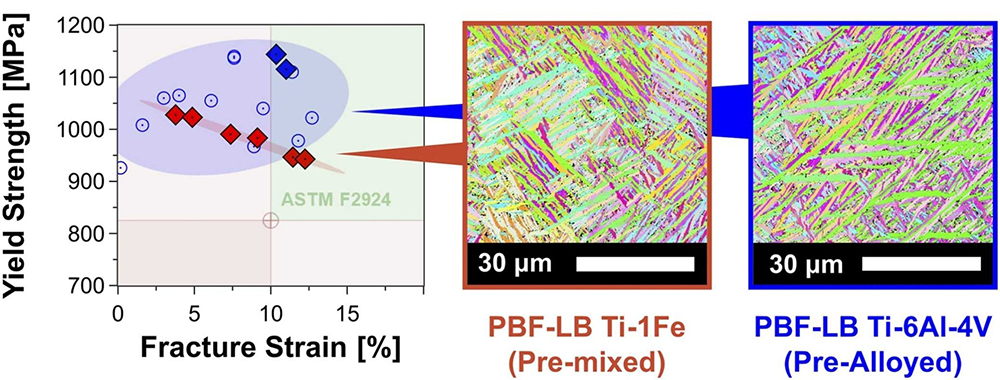
Harnessing AM kinetics to obtain similar properties from a cheaper composition.