
Metallurgical Abstracts on Light Metals and Alloys vol. 58
Stress Increase by Nanoscale hcp Precipitates in HfNbTaTiZr High Entropy Alloys
Hiroyuki Y. Yasuda*, Yusuke Yamada*, Masato Onishi*, Hiroki Suzuki*, Ken Cho*, Satoshi Ichikawa** and Takeshi Nagase***
* Graduate School of Engineering, The University of Osaka
** Research Center for Ultra-High Voltage Electron Microscopy, The University of Osaka
*** Graduate School of Engineering, University of Hyogo
[Published in Scripta Materialia, Vol.255 (2025), 116401]
https://doi.org/10.1016/j.scriptamat.2024.116401
E-mail: hyyasuda[at]mat.eng.osaka-u.ac.jp
Key Words: High entropy alloys, Refractory metals, Plastic deformation, Phase transformation
HfNbTaTiZr high entropy alloys show a stress increase around 873 K, especially in the single crystals. We found for the first time the body-centered cubic (bcc) single phase is decomposed into the bcc1 and bcc2 phases due to spinodal decomposition with composition modulation along <100> direction at 873 K. The bcc1 phase has Zr- and Hf-rich composition, while Nb and Ta are enriched in the bcc2 phase. Next, the hexagonal close-packed (hcp) phase is precipitated along the bcc1 phase. As a result, the hcp phase is aligned parallel to {100} plane of the bcc phase. The fine hcp phase acts as a strong barrier to the dislocation motion, resulting in the stress increase at 873 K.
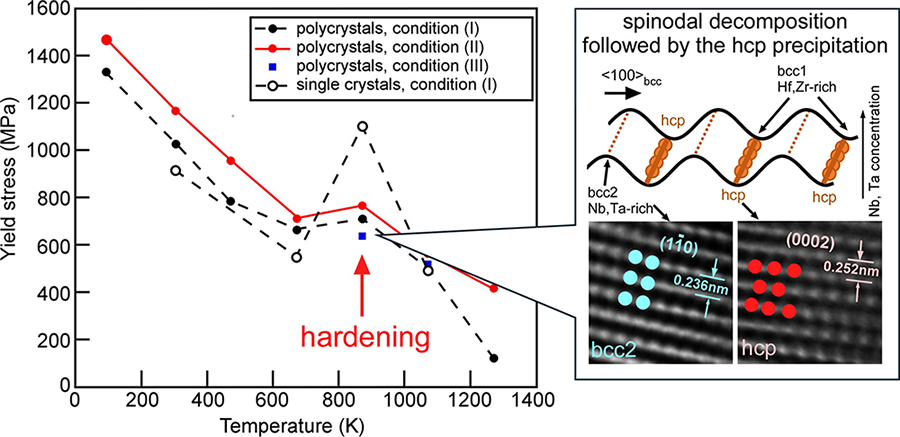
Temperature dependence of yield stress of HfNbTaTiZr polycrystals compressed under different conditions (a). Spinodal decomposition of the alloy at 873 K (b).