
Metallurgical Abstracts on Light Metals and Alloys vol. 58
Variation of Cu Distribution in Surface Oxide Layer of Ti-Cu Alloy with Heat Treatments
Satoshi Okano, Yuichiro Toshinari*, Yuta Hisamori** and Sengo Kobayashi
Graduate School of Science and Engineering, Ehime University
* Graduate Student, Ehime University. Present address: SHINKO WIRE COMPANY, LTD.
** Graduate Student, Ehime University.
[Published in Materials Transactions, Vol. 66, No. 5 (2025) pp. 622-628]
https://doi.org/10.2320/matertrans.MT-MC2024017
E-mail: kobayashi.sengo.me[at]ehime-u.ac.jp
Key Words: Titanium-copper alloy, Oxide, Surface, X-ray photoelectron spectroscopy
Surgical treatment of severe bone fractures is possible using Ti alloy-based artificial bone. However, infections caused by bacterial proliferation at the replacement material remain a critical issue. This study aimed to add antibacterial properties to Ti by adding Cu, which was recognized for its antibacterial effects. Ti-(5, 8, 10 at%)Cu alloys were fabricated, and heat treatments were performed at temperatures ranging from 300 to 1000°C in the Ar and Ar-2% O2 gas atmosphere. The effect of heating temperature and atmosphere on the distribution of Cu at the sample’s surface was investigated. Figure 1 shows the depth profile of Cu concentration of as-polished and heat-treated Ti-10 at%Cu alloys evaluated using XPS. The Cu concentrations at the surface of the as-polished sample and the heat-treated samples at temperatures above 700°C were lower than the average Cu concentration, 10 at%. The enrichment of Cu at the surface of the oxide layer formed on the sample’s surface is achievable through the heat treatments in an Ar or Ar-2% O2 atmosphere at 500°C. The appropriate heat treatments avoid the formation of the Cu-depleted layer on the surface of Ti-Cu alloys, expecting to maintain the antimicrobial properties of the alloy.
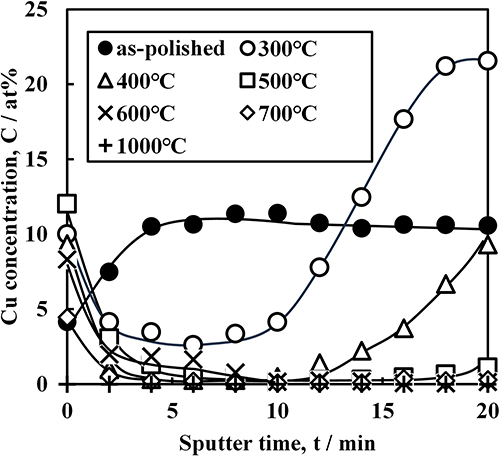
Figure 1 Depth profiles of Cu concentration for the Ti-10 at%Cu alloys, as-polished and heat-treated at various temperatures in an Ar atmosphere.