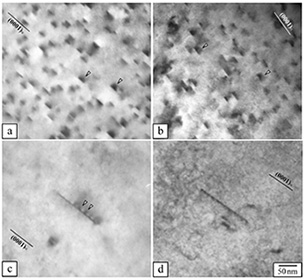
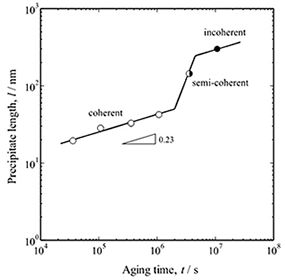
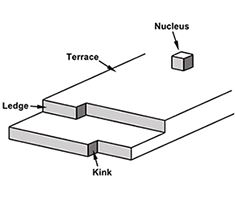
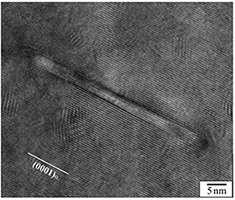
The coarsening kinetics of a fine C15–Al2Ca Laves phase with a plate-like morphology precipitated within the primary α-Mg grains were investigated for Mg–5Al–1.5Ca alloy aged at 523 K. The Al2Ca precipitate coarsened as its coherence was retained in the aging time below 300 h, and a quantitative relationship was obtained between precipitate length (l) and aging time (t) as l ∝ t0.23. However, the α/C15 coherent interface changed into a semi-coherent interface by introduction of misfit dislocations on the planar surface of the precipitates in the aging time above 300 h, which resulted in the promotion of Al2Ca coarsening. The Al2Ca phase was assumed to precipitate through a nucleation and growth mechanism rather than spinodal decomposition, and its coarsening was explained using the terrace-ledge-kink mechanism. The result shows that the aspect ratio of the Al2Ca precipitates was predominantly determined by the aging temperature, and it decreased at higher aging temperatures.
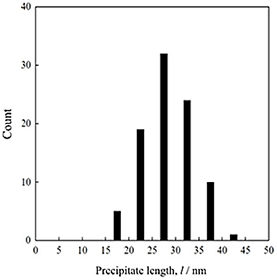
Figure 1 shows the TEM BFIs of the Mg–5Al–1.5Ca alloy aged at 523 K for (a) 30 h, (b) 300 h, (c) 1000 h, and (d) 3000 h, taken with B = [11-20]α, g = 0002α. The strain contrast around the C15–Al2Ca precipitates is indicated with arrowheads in (a), (b), and (c). Figure 2 shows the size distribution of C15–Al2Ca precipitates observed in the Mg–5Al–1.5Ca alloy aged at 523 K for 30 h. The number of measured precipitates is 91. Figure 3 shows the plots for the Mg–5Al–1.5Ca alloy of the C15–Al2Ca precipitate length vs. aging time at 523 K. Figure 4 shows the matrix-precipitate interface illustrating the terrace-ledge-kink mechanism. Individual atoms are represented as cubes. Figure 5 shows the HRTEM image of coherent C15–Al2Ca precipitate observed in the Mg–5Al–1.5Ca alloy aged at 573 K for 1 h, taken with B = [11-20]α.