Most of the structural aluminum alloys for industrial use are coarse-grained materials with a grain size of larger than 10 µm. Therefore, it is important to clarify the dislocation density multiplication behavior during deformation of the coarse-grained materials in terms of industrial importance. However, the change in dislocation density by in-situ XRD measurement in coarse-grained material using synchrotron radiation has not been investigated. The Williamson Hall method is often used to obtain the dislocation density from the XRD measurement results, and this method requires measurement of the diffraction angles and half widths of many diffraction peaks. This is because when the number of grains is small in the scattering volume, such as with coarse-grained materials, the diffraction pattern becomes a discontinuous spot, and a smooth diffraction profile cannot be obtained. Therefore, in this study, we tried to measure the change in dislocation density during tensile deformation of aluminum alloy coarse-grained material by increasing the effective scattering volume by swinging the tensile test piece together with the test machine during deformation.
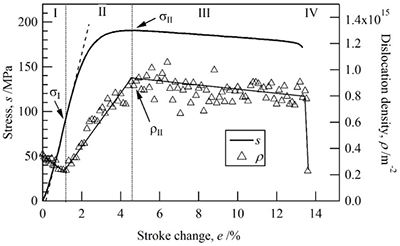
Figure 1 shows the change in dislocation density during tensile deformation in an ARB material with a grain size of 500 nm. The dislocation density changed through the four regions as reported in the previous results. Region I is an elastic deformation region and the dislocation density does not hardly change. When the region shifts to the region II, dislocations increase rapidly up to ρII, and when the region shifts to the region III, the dislocation density increases slowly. ρII means the minimum dislocation density required for plastic deformation, and the ρII was 1015 m-2.
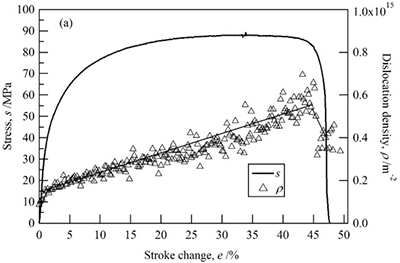
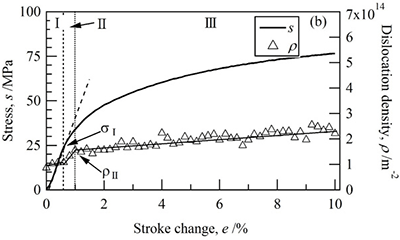
Figures 2 shows the change in dislocation density during tensile deformation in a coarse-grained material with a grain size of 20 µm. The dislocation density changed through four regions as in the case of the fine-grained material. It was found that ρII was 1014 m-2, and the dislocation density required for plastic deformation in the coarse-grained material is smaller than that in the fine-grained material. In addition, since ρII is small, the dislocation density reaches ρII immediately after the start of dislocation multiplication, and therefore region II was quite short in the coarse grain material.
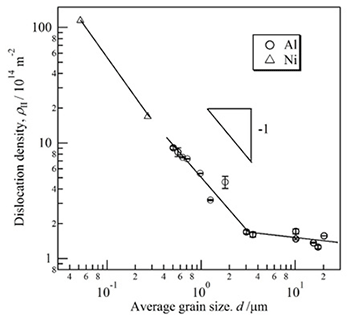
Figure 3 shows the change of ρII depending on the grain size. On the coarse grain side, ρII was almost constant and was about 1014 m-2. However, when the grain size was less than 3 µm, ρII monotonously increased in proportion to the -1 power of the grain size. This was the same tendency in nanocrystalline nickel measured in the past. From this result, it became clear that in order to understand the mechanical properties of fine-grained materials accurately, it is necessary to consider the long region II and ρII which greatly increases due to the refinement of grain size. This was the same trend as the result measured for nanocrystalline nickel. From these results, it is clear that it is necessary to consider the existence of the long region II and the effect of a large increase of ρII due to the grain refinement in order to understand the unique mechanical properties of the fine grain material.