Light elements such as oxygen (O), nitrogen (N), carbon (C), silicon (Si) and hydrogen (H) are well-known interstitial solid solution elements for titanium (Ti), and the previous studies clarified their solution strengthening effects of powder metallurgy (PM) α-Ti materials while an enough ductility such as more than 20% elongation is obtained [1-6]. On the other hand, the conventional cast Ti materials with the light elements show a very low ductility due to their agglomeration at the grain boundaries during solidification [7]. In case of nitrogen solution, fine TiN particles are employed as the starting material of nitrogen suppliers. There is, however, a serious problem regarding the agglomeration phenomenon of TiN particles in the pre-mixed Ti-TiN powder, resulting in the materials defects of PM Ti-N materials. In this study, Ti powder with high nitrogen solutes and coated with Ti2N/TiN layers, called as “core-shell structured Ti powder” was successfully developed as the starting material. The Ti-(N) powder was subsequently consolidated by spark plasma sintering (SPS), followed by hot extrusion process. The microstructures and mechanical properties of Ti-N materials were investigated, and then the nitrogen solution strengthening mechanism was quantitatively discussed.
A commercially spherical pure Ti grade 1 powder, having a mean particle size of 62.3 µm, was employed. The impurity contents of oxygen, nitrogen, and hydrogen were 0.078, 0.016 and 0.002 mass%, respectively. To expose the titanium powder to nitrogen, pure Ti powder was heated in a horizontal tube furnace under a nitrogen gas atmosphere for 10 min with a nitrogen gas flow rate of 5 L/min. The nitrogen content in the treated Ti powder was controlled by adjusting the heat treatment (HT) temperature between 640 °C and 800 °C. The core-shell structured Ti-(N) powder was consolidated by spark plasma sintering (SPS) at 1100 °C for 1 h by applying 30 MPa pressure in a vacuum (<6 Pa). After pre-heating the sintered Ti billet in an argon gas atmosphere, it was immediately extruded to the full-dense rod, where a pressing speed and an extrusion ratio were 6 mm/s and 18.5, respectively. The microstructure and texture were characterized by an optical microscope (OM), scanning electron microscope (SEM), and electron backscatter diffraction (EBSD). The elemental distribution was analyzed by using energy-dispersive X-ray spectroscopy (EDS) and an electron probe microanalyzer (EPMA).
The mechanical properties were investigated by using two techniques; micro-hardness and tensile testing at room temperature, where a nominal strain rate was 5×10⁻⁴ s-1.
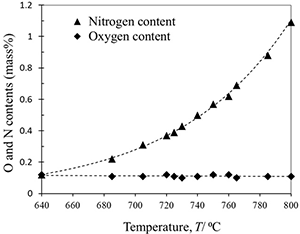
Figure 1 presents the relationship between the nitrogen content and HT temperature as an exponential function, as measured by a simultaneous oxygen/hydrogen/nitrogen analyzer. The nitrogen content strongly depended on the HT temperature [8]. The previous study [9] reported that nitrogen diffusion in α-Ti was found to obey the relations which the coefficient of diffusion can be expressed as D = D0 exp (-Q/RT), where D0 is a temperature-independent pre-exponential (m2/s), Q is the activation energy, R is a gas constant and T is temperature (Kelvin). The oxygen content was approximately 0.11 mass% and almost the same as that of the initial Ti powder. The nitrogen content increased gradually as the HT temperature increased and up to 1.1 mass% at 800 °C. It shows that the nitrogen content of the Ti powder via the nitriding process is simply controlled by changing the HT temperature, and caused no oxidation behavior in HT.
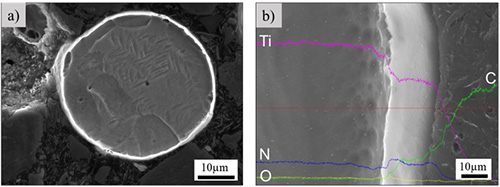
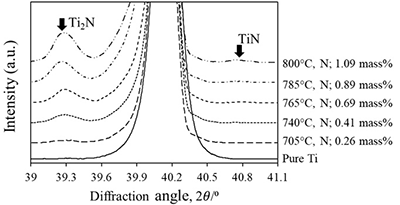
Figure 2 shows the line scan analysis at the cross section of the nitride Ti powder captured by EDS, revealing that a nitrogen enrichment region occurred as a 1 µm thick shell around the Ti. XRD analysis on the nitrided Ti powders (Fig. 3) presents the XRD patterns as a function of nitrogen content and HT temperature. Clearly, the initial Ti powder is α-Ti, and a Ti2N peak was observed at an angle of 39.3° after nitriding. This particular peak intensity increased proportionally to the nitrogen content. A small XRD peak of TiN was also detected in the powders treated at 785 °C and 800 °C. According to the Ti-N binary phase diagram [10], these HT temperatures affect the nitrogen diffusion into the Ti powder surface. Hence, result in the formation of TiN and/or Ti2N at different thermodynamic conditions as products of chemical reactions and nitrogen solid solution [11,12].
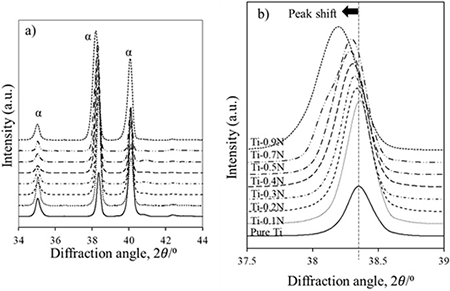
The XRD patterns for all extruded materials containing 0.02, 0.12, 0.22, 0.28, 0.39, 0.52, 0.69 and 0.89 mass% nitrogen are shown in Fig. 4(a). Only α-Ti peaks were observed, and there were no precipitates detected such as Ti2N and TiN. In Fig. 4(b), the main (0002)α Ti peak gradually shifted to a lower diffraction angle due to the nitrogen atom solid solution which caused the lattice parameter to expand. In contrast, the (1010)α peak did not shift with increasing nitrogen solid solution content. Because the atomic radius of nitrogen (approx. 0.77 Å) is smaller than that of titanium, the nitrogen atoms can dissolve into interstitial sites, (mainly in octahedral sites), which remarkably affects to increase the lattice parameter of (0002)α.
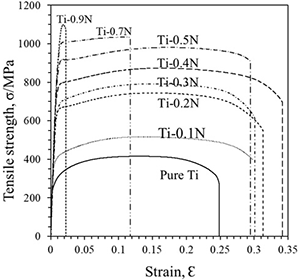
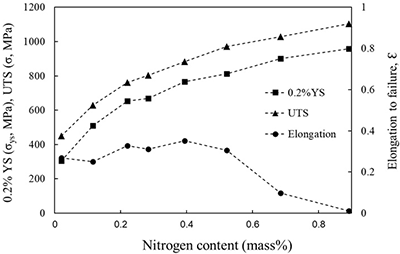
Figure 5 shows the stress-strain curves acquired from the room temperature tensile testing of the extruded Ti materials. The yield stress and ultimate tensile strength of specimens ranged between 305 and 959 MPa and between 450 and 1104 MPa, respectively, with the stress and strengths proportional to the nitrogen contents (0.02 to 0.89 mass%). On the other hand, elongation reached up to 31% for Ti alloys with a nitrogen content of 0.52 mass%, which was higher than the extruded pure Ti by approximately 20%. However, at levels of 0.69 mass% and 0.89 mass%, the elongation decreased to 9.7% and 1%, respectively, as shown in Fig. 6. The results agreed with previous studies where a mixed Ti-TiN powder was used as a starting material, and the ductility often dramatically decreased while the strength of titanium increased at room temperature as a result of interstitial nitrogen. The ductility of extruded Ti-0.3N in this work maintained a 30% elongation, which was higher than that of mixed Ti-TiN powder in previous studies. It is also worthwhile to note that the additional heat treatment after the SPS process significantly improved ductility by homogenizing nitrogen into the Ti matrix. The present powder preparation method achieved outstanding results using this fabrication method.
References:
[1]
S. Kariya, M. Fukuo, J. Umeda, K. Kondoh, Mater. Trans. 60 (2019) 263-268.
[2]
K. Kondoh, R. Ikemasu, J. Umeda, S. Kariya, A. Khantachawana, Mater. Sci. Eng. A, 739 (2019) 491-498.
[3]
K. Kondoh, A. Issariyapat, J. Umeda, P. Visuttipitukul, Mater. Sci. Eng. A, 790 (2020) 139641.
[4]
T. Mimoto, J. Umeda, K. Kondoh, Mater. Trans., 56 (2015) 1153-1158.
[5]
X.X. Ye, J.H. Shen, B. Chen, G.Q. Han, J. Umeda, K. Kondoh, Mater. Sci. Eng. A, 679 (2017) 543-553.
[6]
S. Li, B. Sun, H. Imai, T. Mimoto, K. Kondoh, Composites A, 48 (2013) 57-66.
[7]
H. Conrad, Prog. Mater. Sci. 26 (1981) 123-403.
[8]
A. Anttila, J. Räisänen, J. Keinonen, Appl. Phys. Lett. 42 (1983) 498-500.
[9]
E. Metin, O.T. Inal, Metall. Trans. A. 20 (1989) 1819-1832.
[10]
H.A. Wriedt, J.L. Murray, Bull. Alloy Phase Diagrams. 8 (1987) 378-388.
[11]
H. Skulev, B. Drenchev, T. Mechkarova, L. Drenchev, J. Mater. Sci. Technol. 22 (2014) 57-75.
[12]
E. Roliński, Mater. Sci. Eng. 100 (1988) 193-199.