Some actual examples of UFG materials that could overcome the strength-ductility trade-off, such as a Mg alloy, TWIP steel, and TRIP steel, were introduced. Each UFG metal showed an unexpected activation of different deformation modes (like unusual <c+a> dislocations in the Mg alloy, nano-twins in the TWIP steel, and deformation induced martensite in the TRIP steel), which regenerated the strain-hardening ability of the materials, leading to high strength and large ductility. Based on the results, a strategy, i.e., sequential nucleation of different deformation modes for regenerating and sustaining high strain-hardening rate, was proposed (Fig. 1). In order to consider the fundamental principle of the nucleation (or activation) of different deformation modes, we also proposed a novel concept of plaston, as a local defective region composed of collectively activated (or excited) atoms to create plasticity of the materials. Understanding of the plaston concept would make it possible to design advanced structural materials controlling the activation of various deformation modes in appropriate timing, and would give a fundamental principle for managing both high strength and large ductility.
Strategy for Managing Both High Strength and Large Ductility in Structural Materials ~ Sequential nucleation of different deformation modes based on a new concept of plaston ~
[Published in Scripta Materialia, Vol. 181 (2020), pp. 35-42]
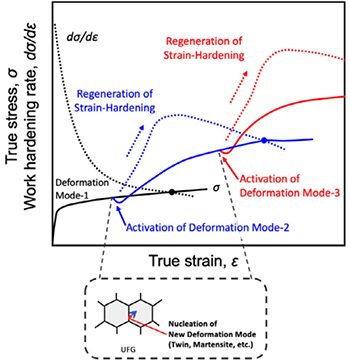
Fig. 1 Schematic illustration showing a new strategy for managing both high strength and large ductility of the materials through sequential nucleation (activation) of different deformation modes and regeneration of strain-hardening ability. An illustration showing the nucleation of a new deformation mode from a grain boundary in UFG materials is shown at lower position, as an example of such a nucleation.