The degradation of charging/discharging capacities in the rate-performance test of lithium iron phosphate (LFP) cathodes with different loading amounts of an active material on both sides of a current collector (i.e., “unbalanced” LFP/LFP cathodes) in a laminated cell (typically composed of anode/separator/unbalanced cathodes/separator/anode) was not observed actually at low C-rates (e.g., 0.1 C). However, the rate-performance data obtained at high C-rates (e.g., > 5 C) indicated that the imbalance of the loading amounts of an active cathode material on both sides of an Al current collector causes a significant capacity degradation. We have found that it is possible to prevent the capacity degradation observed at high C-rates by holing the unbalanced LFP/LFP cathodes in a micrometer-sized grid-patterned way (the percentages of the holed area are typically several %) using a pico-second pulsed laser: The non-holed unbalanced LFP/LFP cathodes exhibited a considerable capacity degradation at C-rates which are, for example, larger than 5C, while the holed ones showed no degradation in capacity even at high C-rates (e.g., 5-20 C). Forming micrometer-sized grid-patterned holes in the LFP/LFP cathodes leads to an improved capacity and high-rate performance of their charging/discharging processes.
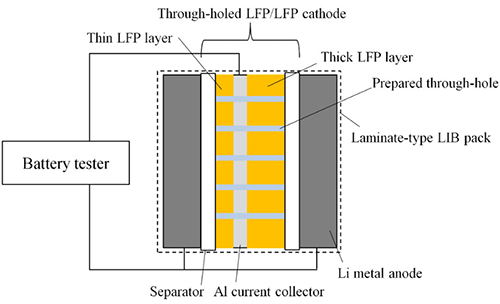
The discharging rate-performance of three kinds of the unbalanced LFP/LFP cathodes, i.e., through-holed, non-through-holed and non-holed unbalanced cathodes (Fig. 1) is examined using parallel-connected batteries which are composed of unbalanced LFP/LFP cathodes and two Li metal anodes in the wide C-rate range of 0.1~20 C at different loading ratios and different loading amounts on both sides.
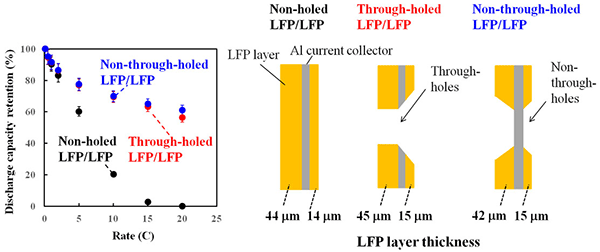
The discharge capacity retention vs. C-rate plots obtained based on the above-mentioned results are shown in Fig. 2 for through-holed, non-through-holed and non-holed LFP/LFP cathodes, respectively, in which the discharge capacity retention was calculated with the following equation.
Discharge capacity retention (%)
= (the discharge capacity observed at a given C-rate) /
(the total theoretical capacity of the cathode used) × 100
(1)
The rate performance decreased with increasing C-rate in all cases of these three kinds of the cathodes and at a given C-rate it is in the order of through-holed cathodes ≧ non-through-holed cathodes ≫ non-holed cathodes (Fig. 2). Interestingly, the high-rate performance of the through-holed and non-through-holed LFP/LFP cathodes was almost the same at a given C-rate irrespective of the LFP loading amounts and ratios on both side of a current collector and the imbalance in LFP loading on both sides did not cause a significant difference in the high-rate performance. On the other hand, in the non-holed LFP/LFP cathodes, the high-rate performance strongly depended on the degree of the imbalance in LFP loading.
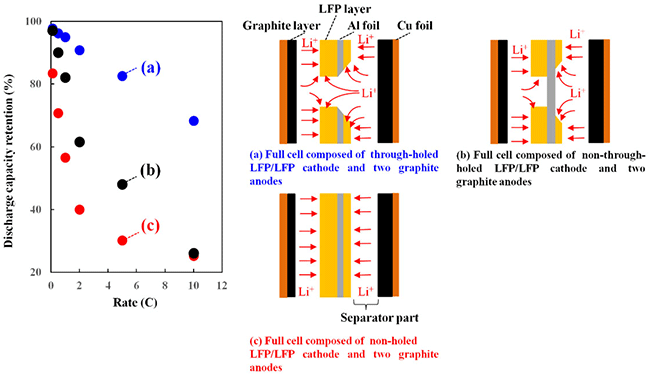
In order to confirm the effect of the holing of the unbalanced cathode with different active material loading amounts on both sides of a current collector upon the high-rate discharging performance, three full cells were prepared (Fig. 3), in which the cathodes with the imbalance ratio of ca. 4:1 were used as unbalanced cathodes with two non-holed graphite anodes. In these full cells, the loading amounts of graphite particles on two copper current collectors (i.e., two anodes) were controlled to make the capacities of the anode and cathode isolated by a separator sheet unbalanced. The capacity of one (or another) anode was matched with that obtained for the LFP cathode layer which does not face it directly. That is, the capacities of the anode and cathode that do not face each other directly were matched. Usually, if the anode and cathode face each other via a separator sheet and their capacities do not match, the capacity observed corresponds to the minor one of either electrode. In the case of the through-holed unbalanced LFP/LFP cathode (Fig. 3 (a)), the discharge capacity retention at 10 C was 70 % which was almost equal to that observed for the cell composed of through-holed LFP/LFP cathode and two Li metal anodes. On the other hand, the full cells composed of non-through-holed (b) or non-holed (c) unbalanced LFP/LFP cathode and two graphite anodes exhibited a largely decreased discharge capacity. These results demonstrate a significant holing effect of cathode in an unbalanced full cell upon the high-rate discharging performance. Especially, the anode and cathode that do not face each other directly can “face electrochemically” through the micrometer-sized holes in Fig. 3 (a), resulting in an improvement in the high-rate discharge performance.
In this study, we have fabricated parallel-connected batteries which are composed of two different (or same) LFP/LFP loading cathodes (i.e., unbalanced (or balanced) LFP/LFP cathodes) and two Li metal anodes and examined their high-rate discharging performance. The unbalanced and balanced LFP/LFP cathodes exhibited the same discharge capacities at low C-rate (e.g., 0.1 C), while at high C-rates (e.g., 5-20 C) the former gave a significantly lower discharge capacity than the latter, reflecting the fact that mismatching of internal resistances of two batteries due to different LFP loadings (i.e., different capacities) can lead to the more resistive battery taking a higher current towards the end of the discharging which results in an accelerated capacity fading. This unfavorable discharging performance of the unbalanced LFP/LFP cathodes at high C-rates could be improved using holed cathodes (i.e., through-holed and non-through-holed ones) in which the LFP layer or LFP/current collector layers are holed at a micrometer size in a grid-patterned way. The improvement in the discharging performance at the holed cathodes at high C-rates can be considered to result from a facilitated transfer of Li+ ions in the discharging of the thick layer as well as the thin one through both the surface and the sidewalls (produced by forming the holes) of the LFP layer (or the LFP/current collector layers). In order to keep a high discharge capacity at high C-rates even in thick LFP layers, resulting in an improvement of the battery performance of LIBs, the optimization of the diameter of holes formed and the percentage of holed areas (i.e., opening rate) is needed and further work along this line is in progress.