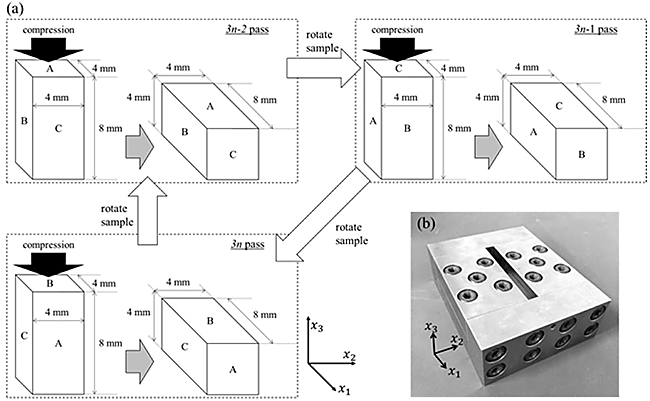
Strengthening behavior of BCC Mg-Li alloys by multi-directional forging have been investigated. LA143 alloys with a high specific yield strength were prepared by heat treatment and multi-directional forging in channel die (MDFC, Fig. 1) which is one of severe plastic deformation.
It was found that
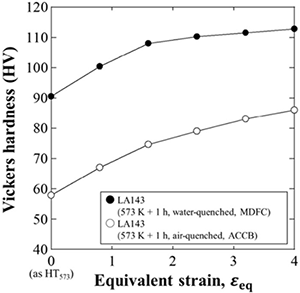
- The Vickers hardness of the LA143 alloy depends on the heat treatment condition. The Vickers hardness of as-HT573K_1h was higher than that of as-HT473K_1h and as-HT673K_1h. Moreover, it was revealed that the cold water-quenched LA143 alloy has a higher Vickers hardness than the air-quenched LA143 alloy, despite its larger grain size.
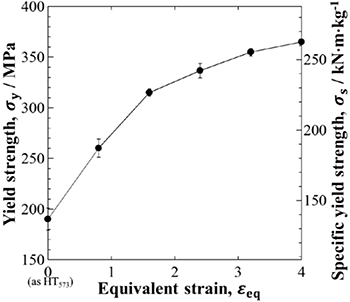
- The Vickers hardness and yield strength of the as-HT573K_1h LA143 alloy sample increased with the number of MDFC passes (Figs. 2 and Fig. 3). Moreover, MDFC LA143 alloy samples showed good deformability. The specific hardness and the specific yield strength of the LA143 alloy samples prepared by heat treatment andMDFC were significantly higher than major conventional lightweight structural materials.
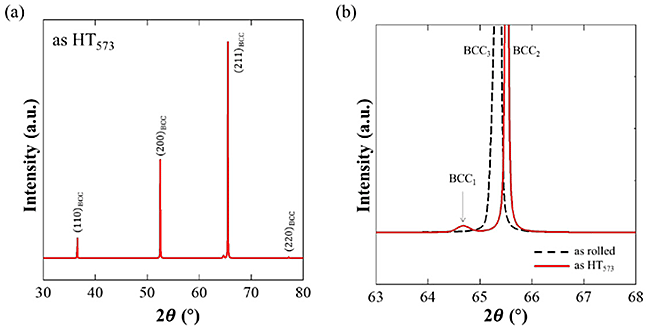
- Spinodal decomposition occurred in the as-HT573K_1h LA143 alloy sample, and not in the as-rolled sample (Fig. 4). It is concluded that spinodal decomposition is the reason for the high strength of the as-HT573K_1h sample.
Future work to be done includes investigating the strengthening mechanisms of this alloy in more detail, by measuring the spatial distribution of the various atomic species, the grain boundaries, and the dislocation density. This will help contribute to further improvements in the mechanical properties of Mg-Li-base alloys.